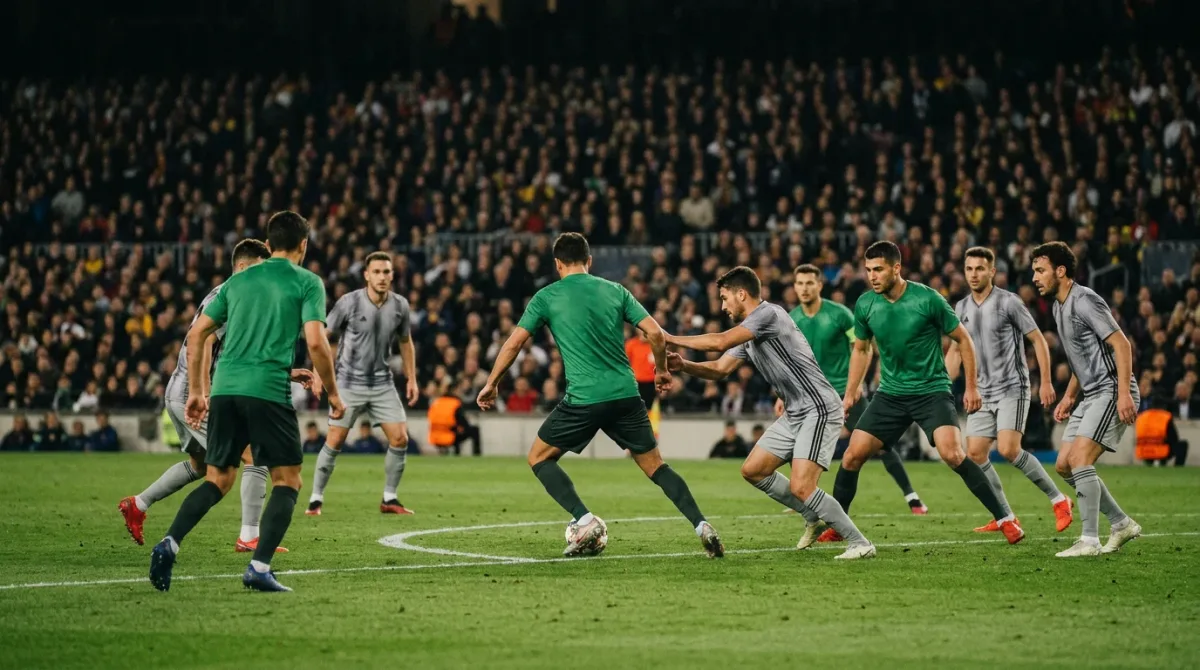
Arsenal's title-winning platform in 2025-26 rested on a full-back stepping into midfield rather than staying wide, converting their defensive four into a back three in possession while conceding a league-low 26 goals across the campaign (SRC-01). The mechanism, refined over several seasons, is the inverted full-back: a left- or right-back who tucks inside alongside the defensive midfielder once Arsenal have the ball, rather than overlapping down the touchline.
What does Arsenal's back three in possession actually look like?
When the inverted full-back steps in, Arsenal's out-of-possession 4-3-3 becomes what has been described as a 3-2-5 shape once they are in control of the ball (SRC-03). Two central defenders are joined by the tucked-in full-back to form the base three, a double pivot sits just in front of them, and five players — the two remaining defenders pushed high plus the front three — occupy the width and final third. That base creates a spare man in central areas against opponents who press with a front two or three, letting Arsenal work the ball through midfield rather than needing to go long or wide to escape pressure.
The trade-off is structural discipline in transition: with a full-back occupying a central lane, Arsenal need their double pivot and inverted full-back to screen the space in behind if possession is lost high up the pitch, since a conventional full-back is no longer tracking back from a wide starting position.
Why did Arteta build the system around an inverted full-back in the first place?
The role was seeded years earlier by Oleksandr Zinchenko, whose ball-playing profile suited tucking inside next to the pivot, and it was intended to expand with Jurrien Timber operating as an inverted right-back before injury repeatedly interrupted his introduction; Ben White filled the role effectively in Timber's absence last season, according to BBC Sport reporting on Arsenal's defensive setup (SRC-02). That same reporting notes Zinchenko's technical ability was never in question, but that he was assessed as prone to switching off in possession and defensive moments — a lapse-risk that matters more in a system where his positioning underpins central control rather than simply supporting an attack from the flank.
Arsenal addressed the position's depth by signing Riccardo Calafiori specifically to strengthen left-back, a player with prior experience in a comparable role at Bologna, per the same BBC Sport report (SRC-02). The signing reflected an acknowledgement that the inverted full-back function needed more than one reliable operator if the base-three structure was to hold up over a full season rather than depend on a single player's fitness and form.
How did that framework hold up personnel changes through the season?
Arsenal did not rely on a fixed spine to make the structure work. Martin Zubimendi's arrival gave Arteta the option of a 4-2-3-1 shape in 13 of the club's 37 league matches, deployed alongside the more familiar 4-3-3 base, with Declan Rice used effectively across each of the midfield's three central positions depending on the matchup (SRC-01). That flexibility mattered because the inverted full-back mechanism depends on a genuine double pivot in front of the back three; rotating Rice through those roles, rather than fixing him in one, let Arteta preserve the central solidity the system needs regardless of which full-back was tucking inside on a given week.
What did the platform produce by the end of the season?
The defensive output attached to this structure was the division's best: Arsenal kept 19 clean sheets in 37 Premier League matches and conceded a league-low 26 goals, with goalkeeper David Raya facing only 87 shots on target across the campaign — fewer than Manchester City's 122, the closest pursuing side (SRC-01). A central platform that limits opposition transitions is a large part of why that shot count stayed low: opponents structurally overloaded in the middle of the pitch generate fewer clean transitions into Arsenal's defensive third than they would against a side conceding wide areas.
The same platform supported an attacking route that had little to do with open play. Arsenal scored a Premier League record 18 goals from corners across the season, built around Declan Rice's inswinging delivery and Bukayo Saka's left-footed corners, with a "near-post rush" pattern of runners moving from the back post toward the front (SRC-01). That set-piece return sat on top of, rather than in place of, the structural control the inverted full-back provided in open play — Arsenal also ran further than 35 of their 37 league opponents across the season and scored 40 second-half goals against only 16 conceded, evidence of a squad able to sustain its defensive shape and pressing intensity for a full ninety minutes (SRC-01).
Taken together, the season's numbers describe a team whose control in central midfield — engineered by pulling a full-back inside rather than adding raw possession share — reduced the shot quality opponents generated and gave a well-drilled corner routine more matches in which a lead was worth defending.
For a related football perspective, read How semi-automated offside technology settles the tightest offside calls.