The most contested trophy in some rivalries is not silver at all. College football in the United States plays for objects like a cannon, an axe and, in one case, a replica of a Vietnam War patrol boat, while football rivalries elsewhere contest bells, shields and entirely invented cups with no federation's blessing. These rivalry trophies persist because they compress a specific grudge into a specific object — a piece of silverware confirms you were good, a rivalry trophy confirms you were better than the one team that mattered. Coverage of college football's trophy games by the Associated Press and other outlets keeps demonstrating the pattern: the objects are absurd, and the affection is total.
What makes an unofficial trophy different from a cup?
Jurisdiction, mostly. Official silverware is issued by a governing body, catalogued, insured and engraved by a committee. A rivalry trophy is usually issued by the supporters, a newspaper or a local businessman, governed by custom, and physically transferred only by beating the rival. Its value runs on provenance rather than metal content. Half the time the object started life as something else — a hat, a bell, a model boat, a barrel — and was conscripted into service because the rivalry needed something to hold.
- Official cup: won in a competition, owned by many clubs over time, meaning derived from the tournament.
- Rivalry trophy: won against one opponent, held until the next meeting, meaning derived from that opponent.
Why does the physical object matter at all?
Because rivalry is abstract and grudges need handles. A head-to-head record is a spreadsheet; a trophy that lives in the winner's trophy cabinet and must be physically surrendered is drama. The object makes the rivalry visible to people who were not there when it started — a new fan can see the thing, read its plaque, and inherit the argument without a history lesson. Museologists would recognise the function immediately: it is a relic, in the strict sense, an ordinary object carrying extraordinary accumulated meaning. That is also why losing one hurts disproportionately. Dropping a league title to a stranger is a professional failure; handing a beloved object to the neighbour across town is a community embarrassment retold for a year.
A head-to-head record is a spreadsheet. A trophy that must be physically surrendered when you lose is drama.
Where did the tradition of odd rivalry trophies come from?
Largely from the late nineteenth and early twentieth centuries, when organised sport was inventing its rituals in public. Newspapers donated cups to stir interest, local dignitaries donated objects to be famous for, and student bodies in American college football escalated each other with increasingly literal hardware — axes, cannons, bells and trophies modelled on military or industrial objects. The fashion spread through international fixtures too: several national-team rivalries acquired named trophies, often sponsored or donated, that supporters treat as more important than the friendly match status of the fixture would suggest. The unifying logic is that a rivalry with an object outranks a rivalry with only a name.
Typical origin stories of rivalry trophies
| Origin | Example pattern | What it signals |
|---|---|---|
| Newspaper donation | Local paper funds a cup | Media-manufactured grudge, adopted sincerely |
| Symbolic object | Bell, hat, cannon, model boat | A local industry or in-joke elevated |
| Escalation gift | One side presents a trophy to own the rivalry | Confidence bordering on provocation |
| Sponsored fixture | Named cup for a regular bilateral match | An invented tradition that took root |
Do players actually care about these objects?
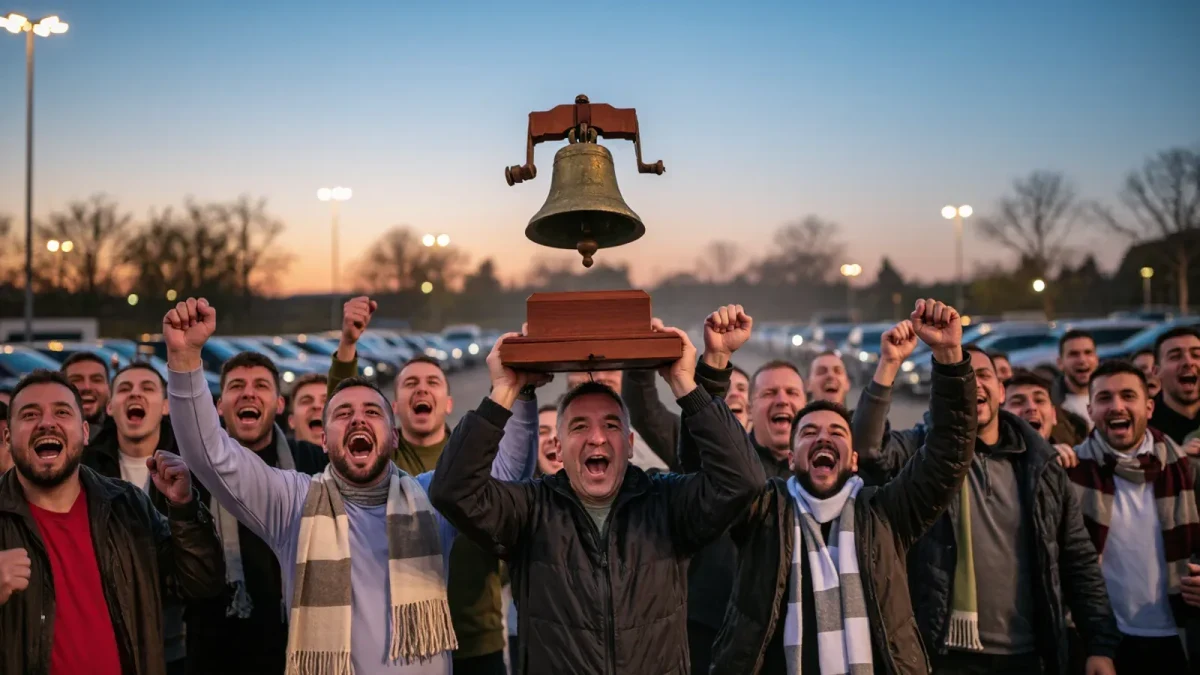
More than their contracts would predict. Players are instructed in the rivalry's meaning on arrival — often by the kit man rather than the coach — and lifting a rivalry trophy in front of the away end is one of the few moments in a professional's season that is unambiguously for the supporters rather than the hierarchy. Former players speaking in retirement interviews, a staple of BBC Sport's features output, routinely rank derby wins and rivalry trophies alongside medals, particularly when the club's season was otherwise empty. The trophy functions as proof that the team understood the assignment: the fans can forgive a bad year if the neighbour did not get the bell.
Why do fans keep inventing new ones?
Because the supply of grudge is renewable and the format works. Supporters' groups, fan media and even sponsors continue to propose trophies for newly heated fixtures, and while most invented traditions die quietly, a few catch on when the rivalry is real and the object is good — specific, slightly ridiculous, locally legible. The paradox of the rivalry trophy is that its power depends on losing it being intolerable. Silverware sits in a cabinet whatever happens next season. A rivalry trophy is only ever borrowed, and every holder knows the return date: the next meeting with the only opponent that counts.
How do you retire a rivalry trophy?
Almost nobody dares. When rivalries fade — a conference realignment, a club's decline, a hundred-year gap without a meeting — the trophies usually survive in glass cases, museum drawers and university archives, labelled and waiting. Archivists at colleges and clubs describe them as some of the most asked-after objects in their collections, because a trophy that stopped being contested did not stop being meaningful; it became history with a handle on it. Occasionally a dormant series resumes and the old object is ceremonially dusted off, and the crowd reacts not as if a trophy returned but as if a century of accumulated grudge did. That is the final proof of the category's power: silverware is retired when the competition ends, but a rivalry trophy is only ever paused. Somebody, somewhere, is still keeping it ready for the next meeting.