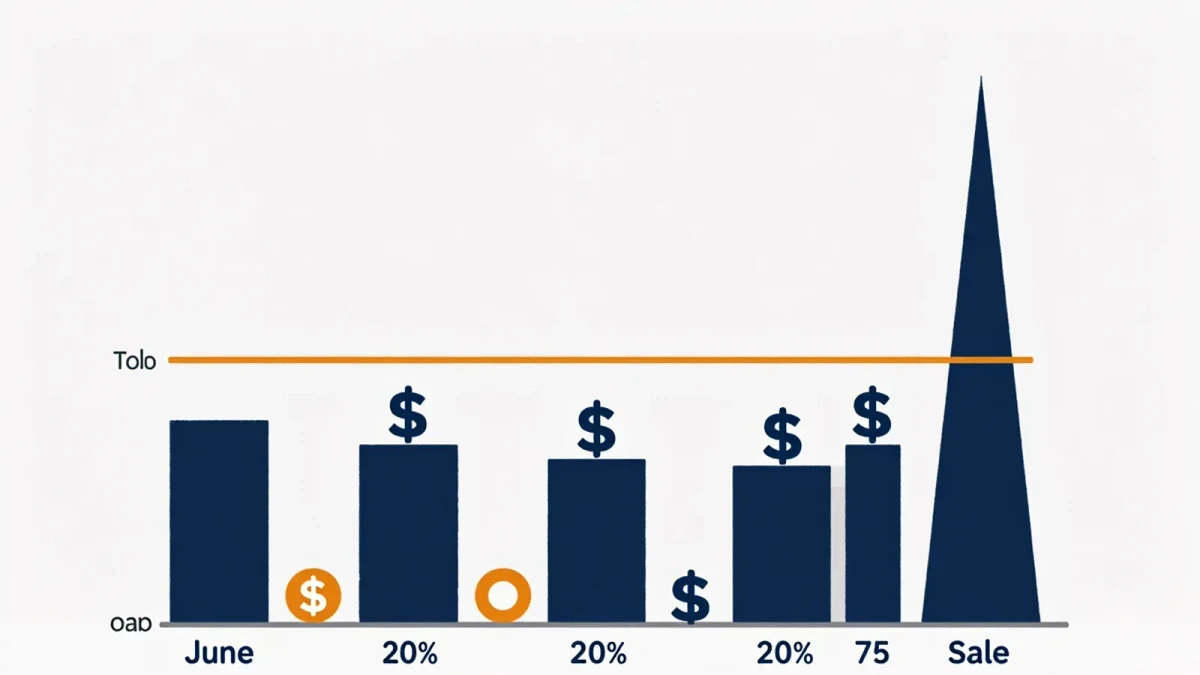
Finance rules have changed not just how much clubs can spend but which players they buy. Under the Premier League's profitability and sustainability rules, clubs may lose no more than £105 million across three seasons before facing charges — a threshold Leicester, Everton and Nottingham Forest all fell foul of in the 2023-24 cycle, with points deductions following for two of them (BBC, 2024). Because every transfer now flows through accounting as much as through scouting, two levers dominate modern strategy: amortisation, which spreads a fee across a contract, and academy sales, which book pure profit. The clubs that master both compete without breaching; the ones that do not face deductions.
How does amortisation shape transfer thinking?
Accounting treats a transfer fee as an asset consumed over the player's contract. A £60 million signing on a six-year deal costs £10 million a year in the books, not £60 million up front — so contract length became a strategic variable. Stretch a deal to eight years and the annual hit shrinks further, which is precisely why leagues moved to cap contract length for amortisation purposes at five years, closing the so-called unlimited-amortisation route that had been used to spread fees across very long deals. Squad planning now openly reflects the arithmetic: clubs prefer young signings on long contracts, with sell-on value, over veterans whose fees cannot be spread and whose value only declines.
Why are academy sales pure profit?
A homegrown player carries no transfer fee on the books, so any fee received for him registers almost entirely as profit in the assessment period. This asymmetry has produced one of the sharpest strategic shifts of the era: clubs under PSR pressure routinely sell academy graduates in June — before the accounting year closes — to balance spending on imports. The pattern repeats across the league: one or two homegrown sales can fund an entire summer window, and rival supporters have learned to read late-June academy departures as a telltale of financial pressure rather than football judgment. The Premier League has since amended its rules to limit how much homegrown sales can offset losses in future seasons, a change the league announced amid its broader rule revision process — evidence that the strategy worked well enough to require correction.
What does a compliant window look like?
The modern template, visible across top-flight clubs, combines several elements:
- Young signings on five-year deals, maximising both amortisation spread and resale potential.
- Structured payments and add-ons, pushing cash and accounting recognition into future periods while inflating headline values for both sides.
- Academy sales or homegrown swaps timed to the accounting year-end to book profit where it is needed.
- Loans and free agents to fill squad gaps without new amortisation lines at all.
How did PSR enforcement change behaviour?
The 2023-24 cycle was the turning point. Everton received two separate points deductions for breaches of the £105 million threshold, and Nottingham Forest a smaller one, after both clubs argued unsuccessfully that selling key players later would have restored compliance. The message the league's commission decisions sent was that timing is not a defence: losses are assessed when booked. Since then, clubs have front-loaded academy sales, traded players between compliant clubs in June, and treated the assessment period as a planning constraint comparable to a salary cap. Leicester's case, which included the club contesting the league's jurisdiction during its relegation season, underlined the other lesson: the rules follow the club, not the division.
Does this make football poorer?
The trade-offs are real. Amortisation-driven strategy favours speculative young signings over ready-made performers, compressing opportunities for players in their late twenties whose fees cannot be spread attractively. Academy sales sever the connection between supporters and local players that clubs spend decades building. And June fire-sales create a two-speed window in which financial deadlines, not football needs, set the market's rhythm. The counterargument is equally concrete: before sustainability enforcement, the alternative was not free spending but insolvency — the English pyramid's record of club failures in the 2010s was the political fact that produced the current rules and, in due course, the statutory regulator.
Where is strategy heading next?
The direction is toward rules tied to revenue rather than absolute losses — squad cost ratio frameworks that cap total spending on wages, fees and agents as a percentage of revenue, of the kind UEFA already applies in European competition. Under such systems the strategic levers stay the same — long contracts, young assets, academy profit — but the ceiling moves with commercial success, rewarding clubs that grow income rather than those that simply cut spending. Transfer strategy has already become an accounting discipline; the next phase makes it an accounting discipline with a growth target attached.