Rest defence — the fixed structure a team leaves behind the ball during its own attacking phases — is the single strongest predictor of how vulnerable it is to counterattacks. When a side commits eight players forward and leaves two defenders plus a goalkeeper, a single intercepted cross can become a 4v3 transition against a scrambling back line. Premier League transition data analysed by Opta in 2023 found that a majority of fast-break goals originated from possessions won within ten seconds of an attacking loss, with the defending structure at the moment of turnover — not sprint speed — separating teams that conceded on the break from teams that did not.
What is rest defence in concrete terms?
Rest defence is the answer to one question: if we lose the ball right now, who is where? The term, popularised in German coaching discourse as Restverteidigung, covers the positioning of the deepest players plus the first counter-pressing screen. A common 4-3-3 rest defence keeps both centre-backs and one holding midfielder in a shallow triangle behind the ball, with full-backs either joined to that unit or high but replaced by a rotating midfielder.
The unit's job is not to defend a normal attack. It defends the worst-case transition: a loss in the final third, a long clearance behind a high line, or a second-ball that springs two runners. That is why rest defence is judged by recovery time and coverage, not by duels won. A three-player rest defence with correct spacing and a controlled height is safer than a five-player unit strung across 70 metres.
Why does height of the last line matter so much?
The height of the defensive line during possession sets the size of the space a counterattack can attack. A line at the halfway stripe leaves roughly 45 metres of grass behind it; a line at 35 metres from its own goal leaves under 15. Long-ball and direct teams deliberately target the first configuration, playing into the channel between the high line and the goalkeeper the moment possession turns over.
But low lines carry their own cost: the attacking team compresses itself into the opposition half slowly, giving the defence time to reset into a mid or low block, which suppresses quick transitions in the other direction. The trade-off is therefore structural, not moral. Coaches choose rest-defence height based on their own recovery speed, the opponent's directness, and the match state — which is why the same team can look transition-proof one week and porous the next without changing a single player.
How do counterattacks actually exploit a weak rest defence?
The classic pattern against a thin rest defence is the third-man release. The defending team's striker wins the first ball or drops it to a midfielder, whose first touch releases a runner into the channel vacated by an advanced full-back. Because the rest defence is narrow — centre-backs plus one holder — the channel attack forces a centre-back into a wide recovery run, opening the box for a second runner arriving from deep.
The second pattern is the wide overload release: a team that builds up down one side stacks four or five players there, and the opponent, on winning the ball, switches play in two passes to the far side where only one full-back and one covering defender remain. Analysts describe this as attacking the press's point of greatest commitment. Both patterns are reasons counter-pressing — the immediate chase after a loss — is taught as part of rest defence rather than as a separate skill: the chase buys the seconds the structure needs to reset.
What does a good rest defence look like numerically?
Across top-five-league analysis in the early 2020s, published frameworks from StatsBomb and Opta converged on a few markers of transition resilience: shots conceded from fast breaks, opponents' direct speed (metres per second of ball movement forward) allowed after a turnover, and the average number of defenders goal-side of the ball at the moment of loss.
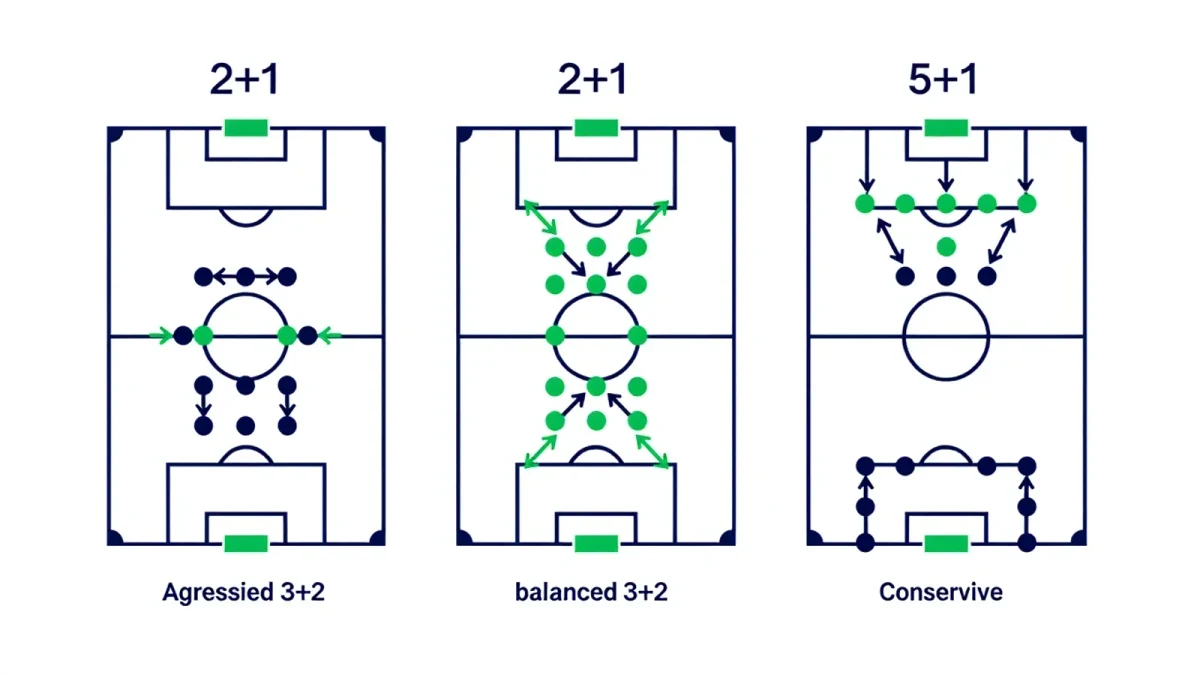
| Rest defence profile | Players behind ball | Risk profile |
|---|---|---|
| Aggressive (2+1) | Two centre-backs, one holder | Fast to counter-press, exposed to long releases |
| Balanced (3+2) | Back three plus double screen | Standard trade-off, resilient to switches |
| Conservative (5+1) | Back five plus holder | Near transition-proof, slow to build pressure |
How can coaches fix a leaky transition without parking the bus?
The cheapest fix is usually structural discipline rather than personnel. First, define a loss line: a zone where, if the ball is lost, the counter-press activates automatically, and outside which players simply recover to shape. Second, assign a permanent balance player — often a holding midfielder — who never joins the attack regardless of match state. Third, cap simultaneous full-back advances at one, keeping a wide defender goal-side at all times.
The deeper analytical point is that counterattack vulnerability is designed, not suffered. It is decided in the minutes a team spends with the ball, in choices invisible on a highlights reel: a centre-back stepping into midfield, a full-back holding his run, a striker showing for a safe lay-off instead of a speculative cross. Rest defence is where those choices accumulate — and where matches on the break are won or lost before the break even begins.
How do coaches train rest defence?
Rest defence is drilled less as a shape than as a set of triggers. Training games impose rules such as a maximum of four players ahead of the ball in attacking phases, or automatic restarts for the opposition the moment a team's defensive line falls below a set number of players. Coaches use small-sided games on wide pitches where every attack must begin from a defined rest structure, so that players internalise the positions before the attack develops rather than sprinting back after the turnover. Video review reinforces the habit: analysts clip the moments three to five seconds before dangerous counterattacks and show which forward runs emptied which covering zone. Over a season this shapes recruitment too, since clubs that attack with committed full-backs increasingly sign centre-backs with recovery speed and midfielders disciplined enough to hold position while teammates join the attack. Rest defence is ultimately a culture, not a diagram, and teams that treat it seriously concede fewer goals from their own ambition.