A pressing trap fails against a single striker because the trap's core mechanism — compressing space around a marked receiver — stops working when the opposition commits only one player forward. Instead of two strikers triggering the press and blocking half the pitch, the defending team must choose which of several free passing lanes to shut, and the numerical advantage inverts. Data published by Opta Analyst in 2023 showed that teams facing a front-two press won the ball in the final third roughly twice as often per match as teams pressing a 4-3-3 with a withdrawn lone centre-forward, a gap that explains why elite coaches calibrate traps by opponent shape, not by intensity alone.
What is a pressing trap, mechanically?
A pressing trap is a coordinated scheme in which one defender deliberately shepherds the ball carrier into a predefined zone — usually a touchline or a full-back's blind reception — where three or four teammates are waiting to collapse on him. The trigger is the moment of initiation: a backward pass, a poor first touch, a fixed reception. The trap is the geometry: the pressing team accepts a temporary positional risk elsewhere to create a 4v2 or 3v1 around the ball.
This mechanism presupposes a predictable receiving target. Traps are designed against teams that build up with two strikers pinning both centre-backs, or with a 4-2-3-1 whose full-backs push high. When those reference points disappear, the defending block loses its map. The players still press with full physical commitment, but the coordinated collapse never arrives, because no single receiver is worth three defenders' attention.
How does a lone striker break the bait?
A single centre-forward changes the arithmetic in three ways. First, he can position himself between the lines rather than against a centre-back's back, so neither centre-back is pinned and both can split wide, creating an extra short option. Second, his starting position 30-40 metres from goal means the ball can be played direct into a contested area where the pressing team has committed players forward and cannot counter-press effectively. Third, and most damaging to the trap, the striker himself becomes an out-ball: a long diagonal or a goal kick over the press turns three committed defenders into spectators in one pass.
The tactical term for this is rest defence bypass — the pressing team's own structure behind the ball is thinned because five or six players are assigned to the trap. Against a front two, a won duel ends the danger. Against a lone striker who drops or holds, the same won duel merely relocates the ball.
Why does spacing defeat intensity?
Modern pressing is often measured by sprint counts and distance covered, but spacing is the variable that decides whether intensity converts into turnovers. A lone striker stretches the first line of build-up horizontally: centre-backs split to the width of the penalty area, the holding midfielder drops between or beside them, and the goalkeeper becomes an extra passer. Suddenly the pressing forward must cover three passing options simultaneously, and his curved run — designed to force the ball one way — forces it nowhere.
Coaches respond by inverting the logic: instead of trapping, the forward screens, cutting the pass into midfield and inviting the ball wide, where a second wave can arrive. That is a lower-risk, lower-reward posture. The trap's whole value was creating turnovers in the final third; a screen concedes possession patience. Teams that keep trapping anyway without the right geometry produce what analysts call a broken press: high positions, no cover, and a rising count of direct attacks conceded.
What do the numbers show about trap outcomes?
League-wide pressing data since 2020 points in one consistent direction: the yield of high turnovers depends more on the opponent's build-up shape than on the presser's own work rate. StatsBomb's post-shot and possession-win models, described in the company's public methodology from 2021-2023, weight field position and coverage at the moment of the duel — not raw duel counts — when valuing a press. In practice that means a 4-4-2 trap against a back three with a lone striker often wins the ball in areas where it cannot be used.
| Opponent shape | Trap trigger clarity | Typical outcome |
|---|---|---|
| Two strikers (4-4-2 build) | High — both centre-backs pinned | Final-third turnovers, direct shots |
| Lone striker, high line | Low — receiver between lines | Bypassed by long diagonals |
| Lone striker, dropping in | Low — extra midfielder appears | Press pulled upfield, space behind |
How should teams adapt mid-match?
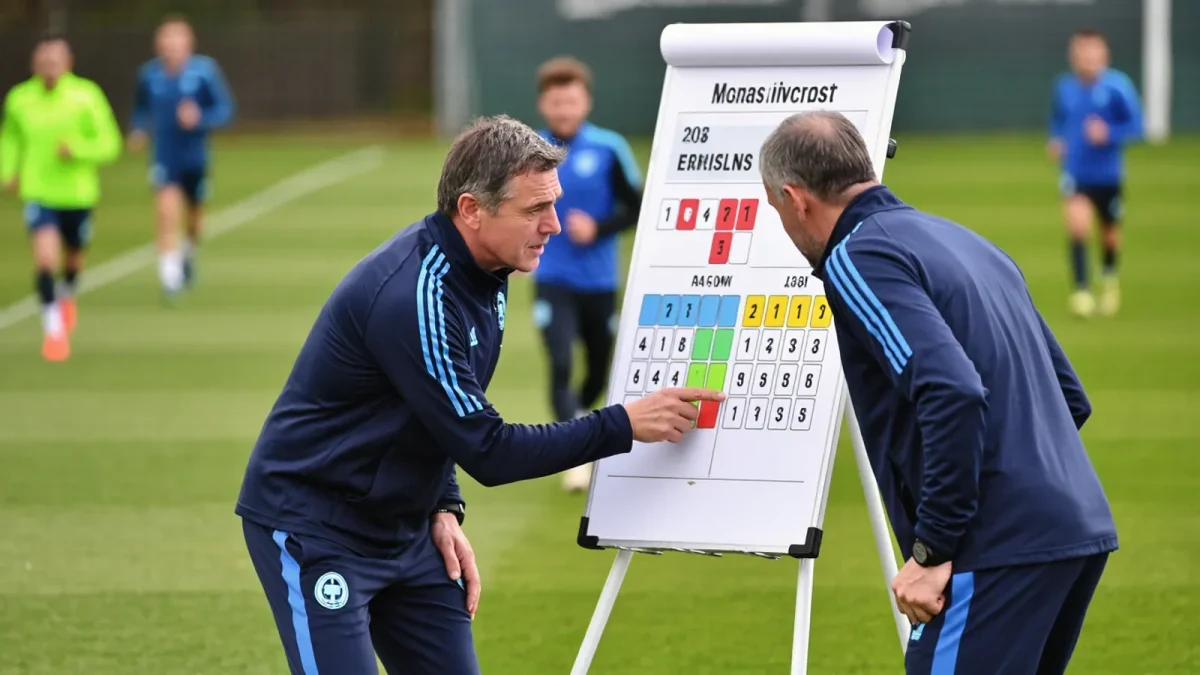
The adaptation that has become standard at the top level is conditional pressing: the forward starts in a screening position and only traps when a specific, coachable trigger appears — a back-pass to a full-back under no pressure, a centre-back receiving with his body open to the touchline, or a goalkeeper taking more than two touches. Each trigger is rehearsed so the collapse behind it is automatic rather than improvised.
A second adaptation is widening the first press to a curve and contain shape, where the striker and one attacking midfielder form a diagonal that blocks the inside pass and concedes the wide one, funnelling play into the touchline zone where the trap was originally designed to work. This restores the trap's geometry without requiring two strikers to exist.
The broader lesson for analysis is that pressing quality is relational. A trap is not a dial marked aggression; it is a response to a specific build-up structure, and a single striker removes the structure the trap feeds on. Teams that keep the mechanism but change the triggers survive the matchup. Teams that only run harder do not.
How do coaches adapt traps against a lone striker?
The standard adaptation is to soften the first line and shift responsibility to the second. Instead of forcing the ball inside, the front line curves runs to shepherd possession toward a touchline, where a wide overload from the midfield line can still apply aggressive pressure in a contained space. Others push one attacking midfielder high to form a nominal front two in pressing phases, restoring the numerical relationship the trap was designed around, at the cost of a lighter presence in central midfield. A third option is patience: accept circulation in harmless zones and trigger the press only on specific cues, such as a pass played backward under pressure or a heavy first touch. Each solution trades something, which is the deeper lesson. A pressing trap is not a switch that works against every shape; it is a bet on where the ball will go, and a single striker changes the odds.