Set-piece coaches earn their pay because dead balls are the most coachable moments in professional football. Open play is chaotic and opponent-dependent, but a corner or a free kick rehearsed hundreds of times can be executed against any opposition. Analysts tracking the Premier League have repeatedly found that roughly a quarter to a third of all goals involve a set piece either directly or from the second phase, a share documented in Opta and StatsBomb publishing from the early 2020s onward. That is the size of the prize, and it explains why clubs that once gave a specialist a part-time consultancy now build whole departments around restarts.
What does a set-piece coach actually do?
The job splits into two halves: attacking design and defensiveorganisation. On the attacking side, the coach builds a library of routines, usually grouped into a small number of choreographed movements that players can run without verbal signals. Each routine attacks a specific defensive setup. If the opponent zones the six-yard box, the routine targets the space in front of the goalkeeper; if the opponent marks man-to-man, the routine uses screens, staggered runs and late blockers to win a half-yard at the near post. Defensive work is less glamorous but just as valuable. The coach decides between zonal marking, hybrid setups and pure man-marking, assigns the tallest players to the highest-value zones, and drills the first line of resistance so that short corners and second-phase losses do not turn into transitions against a stretched shape.
Weekly rhythm matters as much as the schemes themselves. Most specialists get two or three blocked training windows per week, often the day after a match when the squad is fresh enough to repeat jumps and timings without heavy physical cost. Video review runs in parallel: the analyst clips every opponent restart from the previous five matches, tags the marking scheme, the near-post habit and the goalkeeper's starting position, and the coach picks the two or three routines with the best fit. The rest of the week is spent on details most supporters never notice, such as the delivery arc, the taker's run-up angle and the exact step count of the first blocker.
Why did the role become a full-time job?
For most of football history, set pieces were handled by an assistant manager with a whistle and a stack of corners at the end of Thursday training. Three changes turned them into a specialism. First, data became granular enough to separate a good delivery from a good routine, which meant the contribution of a specialist could actually be measured season over season. Second, marginal gains thinking spread from cycling and elite sport science into football after the mid-2010s, and restarts were the obvious untapped margin: high volume, low variance, fully rehearseable. Third, a handful of early hires produced results that were impossible to ignore, and success copied itself the way it always does in coaching. By the mid-2020s most clubs in the top five European leagues employed at least one dedicated restart specialist, and several national teams followed at tournaments.
The economics are flattering to the clubs. A specialist's salary is a rounding error next to a transfer fee, and even a conversion improvement worth three or four goals across a league season can move a mid-table team several places up the table. Analysts who study the Premier League's competitiveness have noted that the gap between mid-table and European qualification has often been smaller than the value of a strong set-piece season, which is why sporting directors treat the hire as one of the cheapest upgrades available.
How is the impact measured?
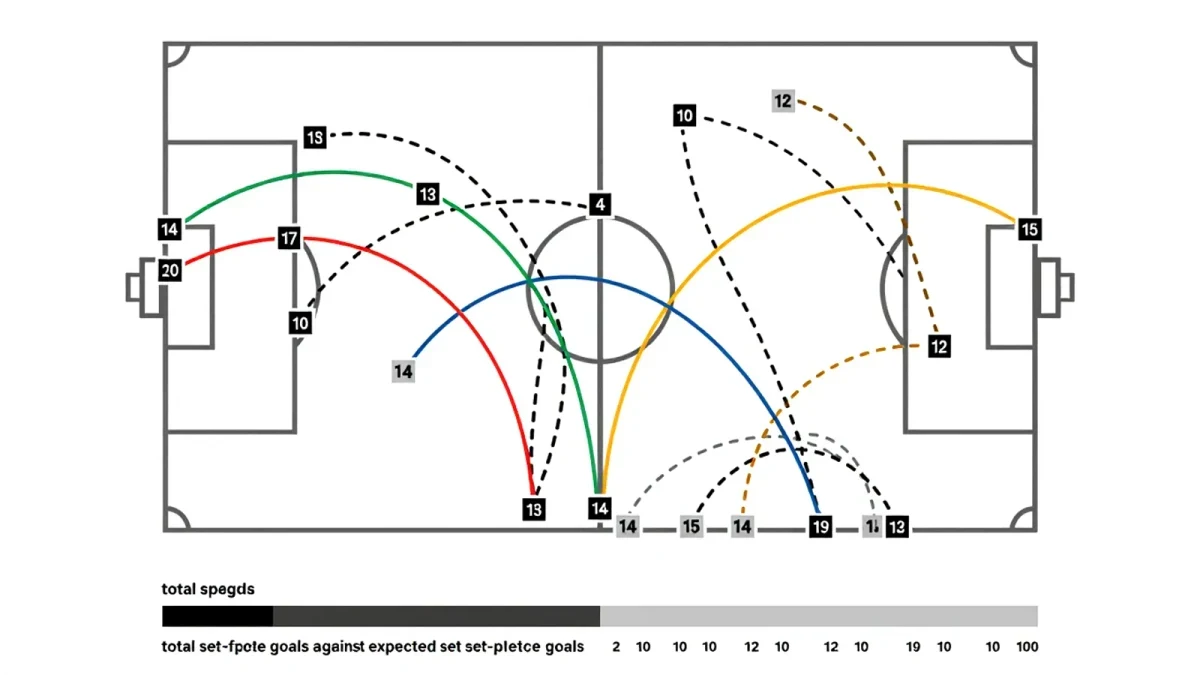
The core metric is set-piece goals above expectation. Analysts model the expected value of every corner and free kick delivery using shot location, delivery type and defensive pressure, then compare the tally a team actually scores with what the model expects. A team that consistently outperforms its expected set-piece value is presumed to be running better routines, better screens and better delivery, though the sample is noisy: the difference between a good and a poor season can be a handful of deflections.
| Measure | What it captures | Typical use |
|---|---|---|
| Set-piece xG per 50 corners | Chance quality created per restart | Comparing routine families |
| Goals above set-piece xG | Conversion edge over a season | Coach and department evaluation |
| Second-phase xG | Value after the initial delivery breaks down | Block design and rebounds |
| Conceded per 50 opponent corners | Defensive organisation quality | Marking scheme audits |
Good departments also track process numbers that stabilize faster than goals, such as percentage of deliveries clearing the first defender, first-contact win rate and the share of corners that force at least a shot. Because goals from corners arrive in lumps, these underlying indicators often tell the club whether the coach is earning the salary before the scoreboard confirms it.
What separates the best routines from noise?
The strongest routines share three properties. They are simple enough to survive a blocked run or a late defensive change. They create a numerical overload in a narrow band of space, usually around the near post or the penalty spot, rather than spreading runners evenly. And they rehearse the second phase, because most corners are cleared and the rebound territory is where rehearsed teams differ most from unrehearsed ones. The classic pedometer of a good routine is not a spectacular flying header but a repeatable pattern that produces similar chances against man-marking and zonal setups alike.
Defensive coaching shows up in quieter ways: a shorter wall that covers the near side of the goal, a zonal player planted on the six-yard line to kill deliveries into the corridor, and a sprinter stationed for the transition when the ball is cleared. None of it photographs well, but the teams that concede few restart goals season after season are almost always the ones that rehearse the boring parts with the same seriousness as the spectacular ones.
Is the edge sustainable?
Partly. Opponents scout routines, and a celebrated corner scheme from one season is usually neutralised the next, which is why the best departments rotate designs rather than relying on a single signature. The durable part of the job is process: consistent delivery quality, rehearsed second phases and a defensive structure that removes easy goals at the other end. When a specialist moves clubs, the routines leave with them, but the habits of preparation tend to stay, and that residue is what clubs are really buying. Set-piece coaching earns its pay not by inventing an unmarked goal but by converting the most controllable thirty seconds in football into a repeatable, measurable advantage.