Football's vocabulary crosses borders because the sport needed words for inventions that had no local name. When Antonín Panenka chipped the decisive penalty of the 1976 European Championship final, the football world simply named the technique after him — "Panenka" now appears in match reports in dozens of languages, from Spanish broadcasts to Japanese commentary. Linguists who study lexical borrowing note that sport is among the fastest vectors for loanwords, and football leads: terms for techniques, tactics and terrace culture migrate with players, managers and television, filling gaps in other languages rather than competing with existing words. Reuters' multilingual match coverage is itself evidence of the shared lexicon, using the same borrowed terms across language editions.
Which football words actually travelled?
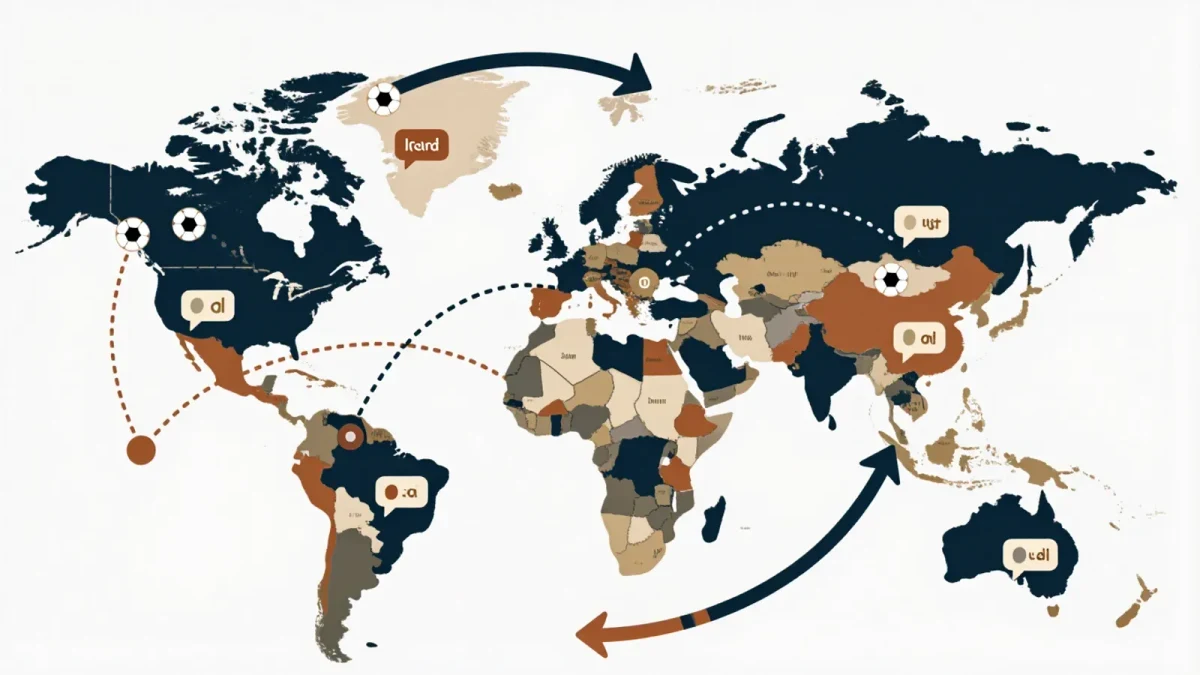
The clearest cases are technique names and tactical labels. The rabona — the crossed-leg strike popularised in Argentina and Italy from the 1950s onward — spread with South American players to Europe and stayed. The Panenka went from a Czech surname to a universal noun within a generation. The libero, Totaalvoetbal's shorthand as "total football," the false nine, the trequartista and the Gegenpressing all moved between languages as the ideas they named moved between leagues. Borrowing runs in every direction: English took "hat-trick" from cricket and exported it everywhere; Spanish and Italian commentary absorbed English match vocabulary; German fans chant English phrases at German matches. The pitch functions as a loanword marketplace.
- Player-named techniques: Panenka, rabona, Marseille turn — the inventor's name becomes the dictionary entry.
- Tactical vocabulary: libero, trequartista, false nine, Gegenpressing.
- Anglicisms: corner, penalty, derby, match — borrowed into most European languages within decades of the sport's spread.
- Back-borrowings: ultras (Italian-born, now global), olé (Spanish, now universal terrace usage).
Why did English become football's lingua franca?
Historical head start plus commercial gravity. Modern football's rules were codified in England in 1863, and the game spread through the British diaspora and trade networks carrying English terminology with it — a diffusion pattern documented in histories of the sport's global expansion. When the commercial era arrived, the Premier League's broadcast reach reinforced the tendency: global audiences absorbed English commentary vocabulary, and even leagues that never fielded an English player adopted English match-day phrases. The effect is strongest where the borrowing is oldest: continental European languages have used "corner," "penalty" and "goal" for so long that speakers no longer register them as foreign. Some of these words even complete a round trip — "fan," borrowed from English worldwide, derived originally from "the fanatic," and returns to Britain in continental forms like "tifo," the Italian-derived word for organised stadium displays.
Some borrowed terms are so old that speakers no longer register them as foreign. The pitch functions as a loanword marketplace.
How do player names become dictionary entries?
Through repetition by commentators under pressure. A commentator sees an unfamiliar technique and needs words immediately; the simplest label is the player's name, and if the technique spreads, the label spreads with it. Lexicographers describe the process as antonomasia — a proper name becoming a common noun — and football supplies constant new examples alongside older ones like the "Marseille turn" or, more recently, eponyms drawn from contemporary stars whose signature moves get named in highlights reels. The naming is democratic: no committee approves a "Panenka." Commentators use it, fans adopt it, and within a decade it appears in dictionaries of several languages.
Football loanwords and their routes
| Term | Origin | Route of spread |
|---|---|---|
| Panenka | Czech player, 1976 | Final broadcast, commentary adoption |
| Rabona | Argentina/Italy, 1950s | South American players in Europe |
| Libero | Italian tactics | Coaching literature, 1960s–70s |
| Ultras | Italian terrace culture | Fan culture diffusion, 1980s onward |
| Gegenpressing | German coaching | Managerial circulation, 2010s |
What does borrowed football language tell us?
That linguistic prestige follows the source of innovation. Languages borrow the word along with the idea: when German coaching dominated tactical discourse, Gegenpressing entered English; when Italian fan culture set the standard for stadium displays, ultras went global; when a Czech did something unprecedented to a penalty, his surname became a noun. Lexicologists treat sport loanwords as a barometer of cultural influence, and football's vocabulary is unusually legible — you can reconstruct decades of tactical and fan-culture history from the direction of the borrowing. The words are a record of who everyone else was watching.
Will the vocabulary keep merging?
The pressure is toward a shared international football dialect: English structural words with continental accents, eponyms from wherever the next unnameable technique appears, terrace slang migrating through social media clips rather than travelling fans. National languages resist where institutions defend them — language academies in France and Spain campaign for native football terms against Anglicisms, with mixed results, and BBC Culture has examined how football vocabulary reflects broader borrowing anxieties. The likely outcome is the one football has always had: a layered lexicon where nobody's language wins, and everyone's best word for a chipped penalty down the middle is, in every language, the same Czech surname.
Which football words refuse to travel?
The ones rooted in local terrace culture. For all the merging, every country keeps an untranslatable layer — specific chants, insults, nicknames and stadium slang that lose their force the moment they cross a border. Translators of football books describe this layer as their hardest task: a nickname that took forty years of terrace history to build cannot be rebuilt in a footnote. English commentary absorbs "tifo" and "ultras" but stumbles on local fan dialects; Spanish keeps its own rich idiom for diving and time-wasting that has no clean English equivalent. The untranslatable layer is, in a sense, the vocabulary's immune system — proof that global football has not flattened local culture but coexists with it. The shared words handle the techniques; the private words hold the feelings, and the feelings, every supporter agrees, are the part that does not export.