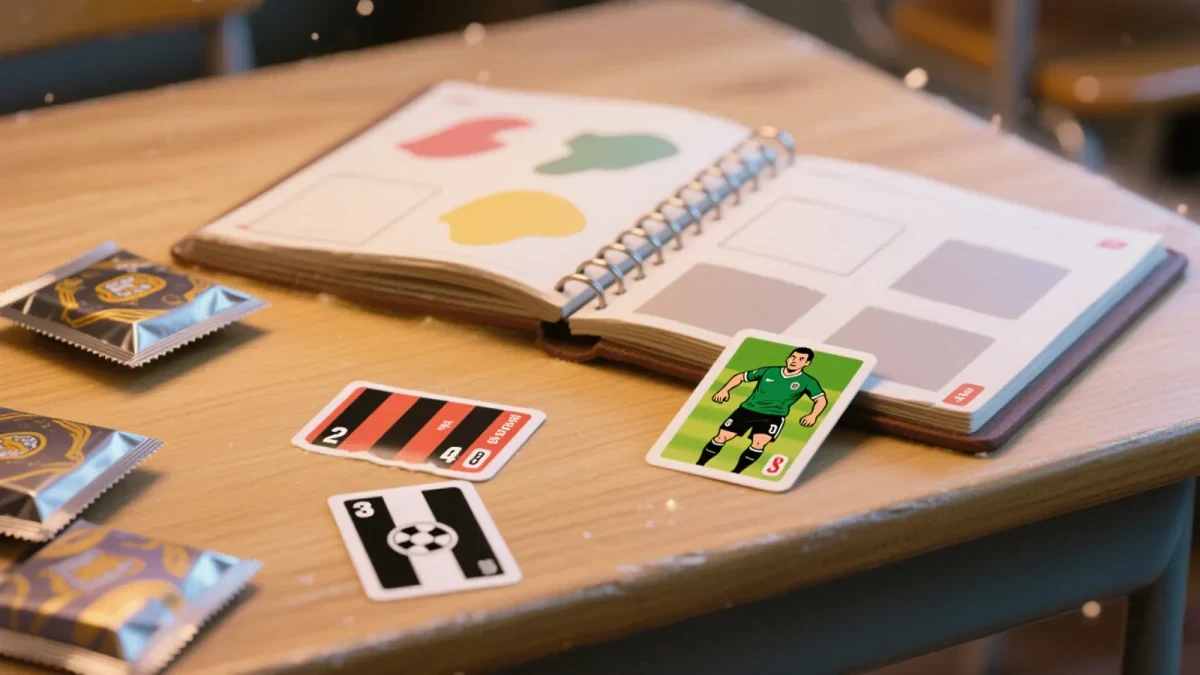
Football stickers survived the digital age because the product was never the image — it was the swap. Panini printed its first football collections in Italy in the early 1960s and its first FIFA World Cup album in 1970, and more than five decades later the albums still sell out around tournaments, with Panini reporting annual revenues in the hundreds of millions of dollars as of the mid-2020s. Every piece of that experience can be digitised except the playground trade: the duplicate, the negotiation, the paper rectangle pressed into another child's hand. Reuters and other wire services have repeatedly covered the World Cup sticker phenomenon as a resilient physical business in an otherwise digital licensing market.
What does a sticker offer that a screen cannot?
Scarcity with a body. A digital card can be rare, but it cannot be bent, lost under a sofa, or traded with a friend behind the school gym. The physical sticker is destructible and therefore valuable; its condition matters, its existence is verified by touch. Collectors describe the album as a slow object in a fast medium — something completed over weeks, one packet at a time, with gaps that ache. Behavioral researchers studying collecting note that near-complete sets are more motivating than complete ones, and the album is engineered around that itch: ninety-eight filled squares and two missing defenders.
Why did the swap become the core ritual?
Because duplicates are a design feature. Roughly a third to a half of any packet is surplus to its buyer, which converts every collector into a trader and every schoolyard into a market. The swap teaches price discovery — a star striker's duplicate is worth two defenders — without anyone naming it economics. That social layer has no digital equivalent at the same scale, and it is self-renewing: each generation of eight-year-olds rediscovers the arbitrage from scratch. Adults who return to the hobby consistently cite the playground trades, not the stickers themselves, as the memory being repurchased.
- Duplicates force interaction. You cannot finish an album alone.
- Prices emerge socially. Value is set by playground consensus, not a listed price.
- Status is visible. A thick stack of swaps is social capital in pocket form.
- The ritual repeats. Every tournament season resets the market.
Didn't the internet kill the playground trade?
It relocated it and, curiously, enlarged it. Online swap groups and marketplaces now let adults complete the albums they abandoned in childhood, while families still buy packets at newsagents. What the internet destroyed — the information vacuum about which stickers were genuinely rare — it replaced with communities that rank, catalogue and authenticate. The physical object gained a digital infrastructure, the way vinyl records gained streaming-era reissues. The album never needed to compete with screens on screens' terms; it needed to remain the thing screens talk about.
Why do adults pay real money for cardboard?
Nostalgia with a catalogue. Because Panini's print runs and roster changes are documented decade by decade, a sealed 1970s packet or a mint-condition album functions like a dated artifact with a reference price. Auction houses have recorded substantial sums for rare vintage football stickers and unopened packets, and collecting outlets track a graded market comparable to coins or comics. The condition-sensitive, generation-anchored nature of the object — most were stuck into albums by children and destroyed by use — makes surviving examples scarce by default. Rarity here was manufactured by enthusiastic eight-year-olds, not by the printer.
Most rare stickers are rare because children did what children do: stick them in, trade them away, ruin them. Survival is the anomaly.
How did the publishers keep the format fresh?
Through controlled evolution rather than reinvention. Glossier stock, updated photography, special and limited-edition runs, licensed tournament tie-ins and, later, digital companion apps — all layered onto a mechanical core that has not changed since the 1960s: buy a packet, find duplicates, trade, fill the album. The mechanics are so stable that each edition feels like a season of a long-running show rather than a new product. Publishers also understood the family transmission channel: parents who collected in the 1980s introduce albums to their children in the 2020s, a free acquisition funnel no startup could buy.
Sticker albums vs fully digital collectibles
| Feature | Paper album | Digital collectible |
|---|---|---|
| Trading ritual | Face to face, social | Marketplace mediated |
| Scarcity | Physical wear and loss | Programmed |
| Completion feeling | Slow, tactile, visible | Instant, abstract |
| Generational handover | Album in a loft | Account-dependent |
What keeps the habit alive for the next decade?
The same stubborn economics of the swap. As more of childhood moves onto screens, the sticker album remains one of the few mass-market objects that requires leaving the house, meeting other collectors and physically exchanging value. Its digital competitors can copy the images and even the scarcity, but not the handshake. Wire-service coverage of tournament-time sticker mania keeps confirming the pattern every two summers: queues, swap meets, family budgets strained by packets. The cassette died because it was only a container. The sticker was never just a container — it was a social protocol printed on paper, and protocols survive medium changes.
What does the sticker revival say about collecting itself?
That completion beats acquisition. Digital collecting offers infinite inventory and therefore no finish line; the album offers exactly one — the final missing sticker pressed into its square — and the finish line is the entire product. Psychologists studying goal pursuit describe the near-complete state as the most motivating phase of any project, and sticker publishers have built a fifty-year business inside that insight. The album also allows a peculiar, adult-free competence: a child who cannot drive, vote or cook can still finish a World Cup album through trading skill and persistence, and the completed object sits on a shelf as evidence. Screens promise endless content; the album promises an ending. In an entertainment economy built on never letting anyone finish anything, an object whose whole point is completion turns out to be the rarest commodity on the newsagent's shelf.