Modern academies track player load through wearable GPS devices, session-rating systems and regular physical testing, because growing bodies respond to training differently than mature ones. A widely cited review of youth football research published in 2020 in Sports Medicine found that monitoring both external load (distance, sprints, accelerations) and internal load (heart rate, perceived exertion) improves the management of injury risk in academy-age players. The practice has spread from elite first teams to under-12 squads, and it has changed how coaches plan weeks around growth spurts.
What does a GPS vest actually measure?
A GPS vest worn under the training shirt carries a small unit between the shoulder blades. The device records position many times per second and converts movement into metrics: total distance, high-speed running distance, sprint counts, accelerations, decelerations and changes of direction. Combined with heart-rate straps, the data gives staff two layers of information. External load describes what the player did. Internal load describes what that work cost the body.
Neither layer means much on its own. A centre-back and a winger can post identical total distances while absorbing completely different physical stress, because the winger's output comes in repeated maximal efforts. Academies therefore track bursts above individual speed thresholds rather than raw totals, and they recalculate those thresholds as players grow.
Why is the acute-to-chronic ratio used?
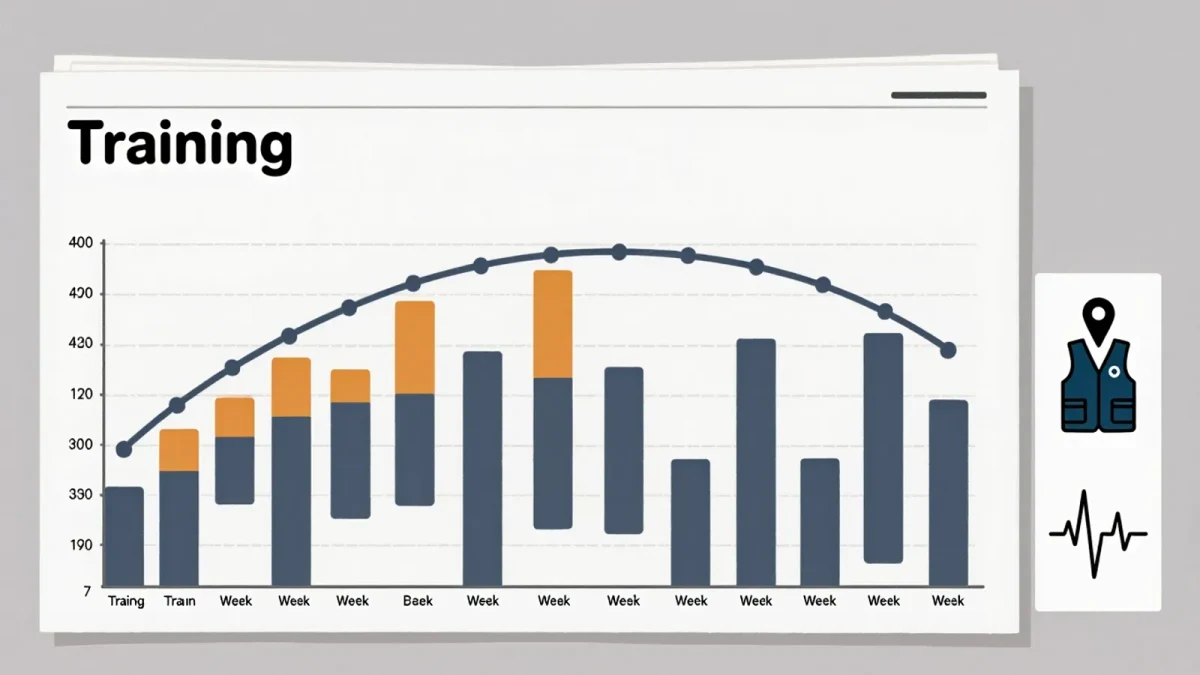
The acute-to-chronic workload ratio, or ACWR, compares a player's recent load — usually the past week — with their longer-term average, usually the past four weeks. The idea is simple: a player whose weekly load suddenly spikes far above what they have been conditioned for is at elevated risk of injury, while a player whose load collapses loses conditioning.
Research popularised by Tim Gabbett and colleagues in the 2010s suggested a rough sweet spot for the ratio, with sharp increases associated with higher injury incidence. Subsequent studies have questioned how precisely the ratio can predict individual injuries, and many sports scientists now treat it as a conversation starter rather than an alarm bell. In academies it works mainly as a flag: a ratio well above the normal range prompts a question about why load jumped, not an automatic benching.
- Acute load: usually the rolling seven-day sum of training and match output.
- Chronic load: the rolling 28-day average, representing what the body is conditioned for.
- Ratio: acute divided by chronic, reviewed alongside soreness, sleep and maturity data.
How does growth affect load management?
Adolescent players do not respond to training in a straight line. During the peak of their growth spurt, roughly between 13 and 15 for most boys and 11 and 13 for most girls, bones lengthen faster than tendons and muscles adapt. That imbalance temporarily raises the risk of overuse injuries such as Osgood-Schlatter disease and Sever's disease, and it can also make coordinated movement harder for a few months.
Academies estimate biological maturity through measures such as percentage of predicted adult height, or in some programmes through skeletal age assessed by wrist X-ray. The point is not to label players but to contextualise everything else: two 14-year-olds six months apart in maturity can have very different sprint capacity, recovery speed and injury tolerance, even in the same match minute.
What is bio-banding and why do academies use it?
Bio-banding groups players by biological maturity rather than chronological age. Instead of an under-15 league, a session might group players within a narrow band of predicted adult height, so a 13-year-old who has nearly finished growing trains with a late-maturing 15-year-old of similar stature.
Research led by Sean Cumming and colleagues found benefits on both sides of the maturity curve. Early maturers, who dominate through size alone in age-group football, are forced to solve problems against bodies as strong as theirs. Late maturers, often crowded out of the game entirely, get touches, duels and decisions they would never see against bigger peers. Players themselves report that bio-banded sessions are tactically harder, which is exactly the point.
What happens on a normal academy week?
A typical monitoring cycle at a well-resourced academy looks less dramatic than the technology suggests. Monday begins with a review of weekend match data and a wellness questionnaire covering soreness, sleep quality, mood and fatigue. Players flagged by the data or their own reports may have their Tuesday session adjusted. Midweek, the physical staff reconcile planned load against delivered load, because a session that looks hard on paper can run light if the pitch is wet or the squad is small.
Before Friday, the plan for the weekend is set with the ratio in mind: a player whose chronic load is low after injury or illness will not be thrown into a full match regardless of availability. The data supports the decision; it does not make it. Coaches still weigh tactical needs, the player's technical programme and simple observation.
| Signal | How it is captured | Typical response |
|---|---|---|
| Sudden ACWR spike | GPS and session data | Reduce intensity, question the cause |
| Growth spurt flags | Maturity estimates, height tracking | Cut plyometric and heavy eccentric load |
| Low wellness scores | Daily questionnaire | Individualised recovery, conversation first |
| Repeated high-speed exposure | GPS bursts above thresholds | Softer week, positional rotation |
Do smaller clubs have to go without?
No. The expensive version of load monitoring uses GPS and heart-rate systems from commercial providers, but the underlying logic works with cheaper tools. Session rating of perceived exertion, where players rate the difficulty of a session on a scale and staff multiply it by duration, produces a usable load number at zero equipment cost. Regular height measurement costs a tape measure. Wellness questionnaires can run on paper.
What matters is consistency. A club that records perceived exertion for every session for two seasons knows its players' normal ranges and can spot the abnormal week. A club that buys vests and reads them only after injuries has data without monitoring.
Where is the line between monitoring and surveillance?
Player unions and researchers have raised a fair concern: young players increasingly grow up with every heartbeat recorded, and the psychological weight of constant measurement is not fully understood. Good programmes treat monitoring as a service to the player, share the data openly, and explain what each number means. Poor ones use it as a selection filter or a stick.
The most experienced practitioners tend to say the same thing: the numbers describe the player, they do not replace knowing the player. Load data has made academy football safer and more rational, particularly around growth and rehabilitation, but its value still depends on the people reading it and the conversations they start. For context on how professional football handles player welfare broadly, coverage such as BBC Sport's football section regularly tracks the topic.