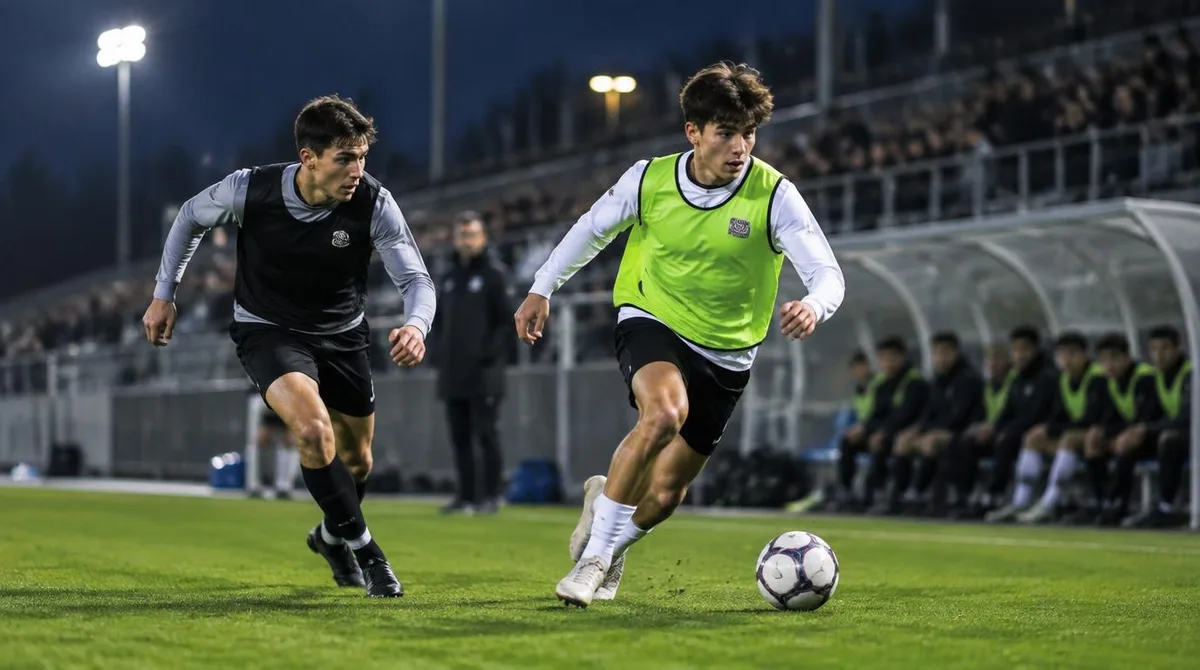
The soccer academy to first team pathway is a sequence of three moves: leaving the academy environment, getting senior-adjacent minutes in reserve or loan football, and then breaking into a first team that owes the player nothing. Most players who sign professional terms never complete all three. The pathway is not a ladder with even rungs; it is a filter, and each stage removes players for different reasons.
This primer maps those stages as they actually work: what the academy phase builds, why reserve and B-team football exists, when a loan helps and when it parks a player, and what the breakthrough window looks like from the club's side. The word "academy" itself needs one clarification for a general audience — football academies are club-run development programs, not schools, though the term overlaps with education. Wikipedia's entry on Staten Island Academy shows the other sense: a private college-preparatory school, founded in 1884, that lists soccer among its athletic offerings and counts the professional US soccer player Chris Agoliati among its graduates. Club academies borrow the school's name but run on a sporting, not academic, mandate.
What does the academy phase actually build?
An academy's job is to produce a player who can survive senior football, not a player who wins youth trophies. The environment does three things. It standardizes technique under pressure, usually through small-sided work where decisions arrive faster than on a full pitch — a method covered in more depth in how small-sided games build decision speed in young players. It teaches positional concepts: pressing triggers, half-spaces — the channels between center and wing — and how a back line steps together. And it socializes the daily habits of a professional: training load, recovery, strength work.
What it cannot manufacture is senior match experience. An under-18 league is still youth football: opponents of the same age, similar physical maturity, forgiving stakes. Selection at this stage also carries known distortions, notably the relative age effect — the documented tendency for older players within an age group to be over-selected — which is examined in why relative age effect still shapes academy selection. So the academy produces candidates, not finished players, and the next stage exists precisely because of that gap.
Why do reserve teams and B-teams exist?
Reserve and B-team football is the bridge between academy and first team. A B-team — a second squad playing in its own league or competition — lets a club keep 17-to-21-year-olds in professional training environments while giving them competitive matches against grown men, some of them experienced professionals rebuilding fitness or fighting for contracts. The stakes are real. The opponents are not 16 years old. That is the entire point.
The design varies by country. Some leagues reserve senior football exclusively for first teams, forcing clubs to choose between loans and an under-23 league. Others permit B-teams inside the senior pyramid. The mechanics of the contract structures that make this work — hybrid deals, B-team contracts, the negotiation over where a young player trains day to day — are set out in how hybrid and B-team contracts bridge the academy gap. What matters for the pathway is the function: reserve football buys time and reps without severing the player from the first-team building.
The common failure mode is stagnation. A player who dominates reserve football for two seasons has answered the questions that level can ask. The evidence on what happens next points one direction: minutes against senior opponents, somewhere, beat another year of comfortable domination — the argument made in why B-team players need game time more than another drill.
When does a loan help a young player?
A loan helps when three conditions hold. The destination offers genuine playing time, not a deeper squad place than the player already has. The style of football suits the player's stage of development — a technical young midfielder gains more from a side that plays through midfield than from one that asks only for duels and long throws. And the parent club stays involved: monitoring minutes, reviewing training, treating the loan as a program rather than a shipment.
A loan parks a player when any of those fail. The classic pattern is a promising 19-year-old sent to a struggling side, used sparingly, coached by a staff fighting relegation with no mandate to develop anyone else's asset. The player returns with 300 uneventful minutes and a worse relationship with the ball than he left with. How clubs structure loans so they develop rather than discard is the subject of how loans should develop young players instead of parking them.
What this means in practice: the loan decision is a joint product of the player's camp and the club, and the player's own representation matters as much as the sporting department. A loan accepted without answers about playing time and role is a gamble dressed as a plan.
What does the breakthrough step actually require?
Breakthrough is the least controllable stage, because it depends on the first team's circumstances rather than the player's merit. The typical openings are structural: a sale, an injury, a suspension, a change of manager, or a squad slot that the club decides is cheaper to fill from within than from the market. Talent gets a player into the conversation; circumstance gets him onto the pitch.
Clubs manage this window deliberately. A young player is usually blooded in low-stakes minutes first — cup matches, late substitute appearances with the result secured — before any start. Managers protect young defenders especially, because individual errors in that position convert directly into goals, a dynamic discussed in why set-piece roles accelerate young defenders' development. The player's job during this phase is unglamorous: train like a starter, take the ten minutes he is given, avoid the injury and the discipline lapses that erase an opportunity.
The transition years that follow — the seasons between first signing and established professional — are where careers are quietly made or lost, and the pattern behind them is analyzed in what transition years reveal about career longevity.
What the pathway teaches about development
The evidence assembled across these stages supports one restrained conclusion: the pathway from academy to first team rewards patience on both sides of the transaction. Clubs that treat reserve football, loans and cup minutes as one coordinated program — rather than three separate boxes — give their young players a fair test. Players who understand that each stage asks a different question, and that the answers are earned in matches rather than in training grounds, position themselves for the window when it opens. What remains unknown, for any individual player, is timing. The pathway can be prepared for; it cannot be scheduled.