Small-sided games build decision speed by multiplying the number of choices a player makes per minute: reduced pitch dimensions, fewer teammates and constant ball involvement force perception, scanning and execution to cycle far faster than in full-size formats. Research published in the Journal of Sports Sciences and related outlets since the 2000s has consistently found that players in small-sided formats touch the ball and make decisions several times more often per session than in 11-a-side play. More decisions per hour, with feedback attached to each one, is the mechanism. Everything else is design.
What counts as a small-sided game?
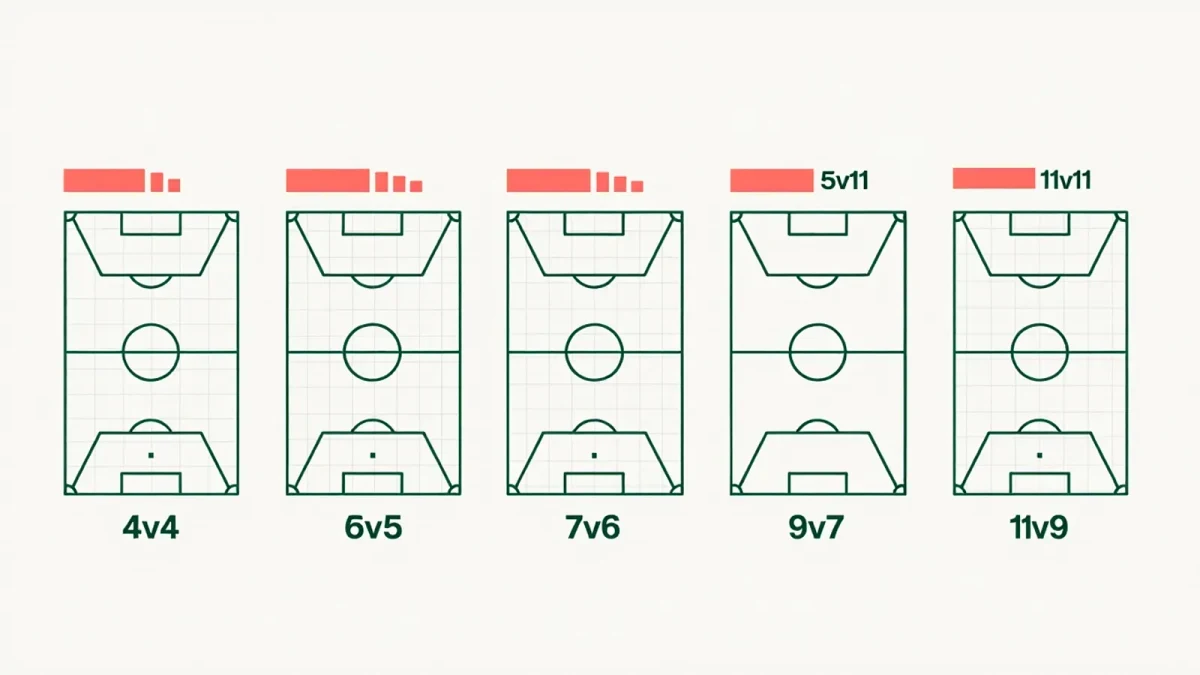
Any scaled-down match: 4v4, 5v5, 7v7, with or without goalkeepers, on proportionally smaller pitches with adapted rules. The format is old — street football and cage football were small-sided by circumstance, not philosophy — but its study is systematic. The most cited body of evidence comes from research on 4v4 football in the early 2000s, which compared young players in small-sided programmes against peers in traditional 11-a-side training and found markedly more touches, passes, attempts and decision situations per player in the small-sided groups.
Why does the format change decisions?
Space and repetition. On a full pitch with twenty-two players, a child may go minutes without touching the ball, and when it arrives, options are often distant and pressure is slow. In a 4v4 on a small pitch, the ball arrives within seconds, an opponent closes within two touches, and two or three passing lanes open and close in the time it takes to look down at the ball. The perceptual cycle — scan, read, decide, act — runs at a rate 11-a-side football cannot approach for a developing player.
The games also punish hiding. In a big match, a hesitant player can stand in a quiet corridor and let the game pass. In a small-sided game, every player is structurally involved; there is nowhere to not decide. That constant demand is what coaches mean when they call the format self-teaching.
What does the research actually show?
Across studies of youth football formats, findings converge on a few points.
- Technical volume rises sharply. Touches, passes, dribbles and shots per player multiply as player numbers fall, with 4v4 formats typically producing the highest individual involvement.
- Physical load stays high. Smaller formats increase the frequency of accelerations, decelerations and direction changes, supporting physical development alongside technical work.
- Decision opportunities scale with involvement. Studies tracking notational data record more on-ball decisions, more 1v1 situations and more transition moments per player.
- Enjoyment and engagement improve. Self-reported motivation tends to be higher in formats where every child is in the game.
How do coaches design games for decisions rather than fitness?
The same structure can be used for very different outcomes, and the difference is in the constraints. To train scanning, coaches shrink the pitch so pressure arrives fast and shrink the touch allowance so the head must be up before reception. To train transition reactions, they add a second ball immediately after a goal. To train support angles, they award points for a goal preceded by a third-man run. To overload a specific decision, they use floaters or numerical advantages so the situation repeats.
The coach's behaviour matters as much as the setup. Interrupting every error to coach freezes the decision cycle and teaches dependence. Letting sequences run, then reviewing a pattern at a natural break, keeps the practice's core asset intact: repetitions under pressure. The best small-sided coaching is mostly silence with occasional precise punctuation.
| Format | Typical use | What it overloads |
|---|---|---|
| 1v1 / 2v2 | Foundation ages | Duels, ball mastery, bravery in contact |
| 4v4 | Core youth sessions | Touches, decisions, transitions |
| 5v5 / 7v7 with keepers | Bridge formats | Positional awareness, build-up choices |
| 8v8 / 9v9 | Pre-11-a-side | Tactical shape, larger-space perception |
Is there an optimal age to use them?
Small-sided games serve every age, but they matter most in the foundation phases. Several national federations, following the research consensus, restructured junior grassroots football in the 2010s so that the youngest age groups play 4v4 or 5v5 on small pitches before progressing through 7v7 and 9v9 to the full game. The logic is developmental economics: a seven-year-old in 11-a-side spends most of the match irrelevant to the ball; the same child in 4v4 makes hundreds of relevant decisions per session.
For older players, the formats shift role. In academies and senior football, small-sided games become intensity tools and tactical rehearsals — possession games with pressing triggers, wave attacks, and finishing games — where the decision cycle stays fast but the content is positional and specific. The scale changes; the principle does not.
What are the honest limitations?
Small-sided games under-train the parts of football that only exist at scale: long-ball flight perception, covering large spaces, managing a full defensive shape, and the specific pacing of an 11-a-side match. A diet of only small formats produces quick deciders with weak spatial maps of the full pitch. This is why developmental programmes sequence formats rather than choose one. It is also why the street-football nostalgia around these games should be kept in proportion — the street produced decision speed precisely because it was small and daily, but modern players also need the full-size game taught deliberately.
Used as the core of youth practice and a permanent tool in senior training, small-sided games remain the most direct known method for building the skill that separates levels: deciding quickly, and being right often enough to matter. Reporting on coaching methods and youth development appears regularly at BBC Sport football.