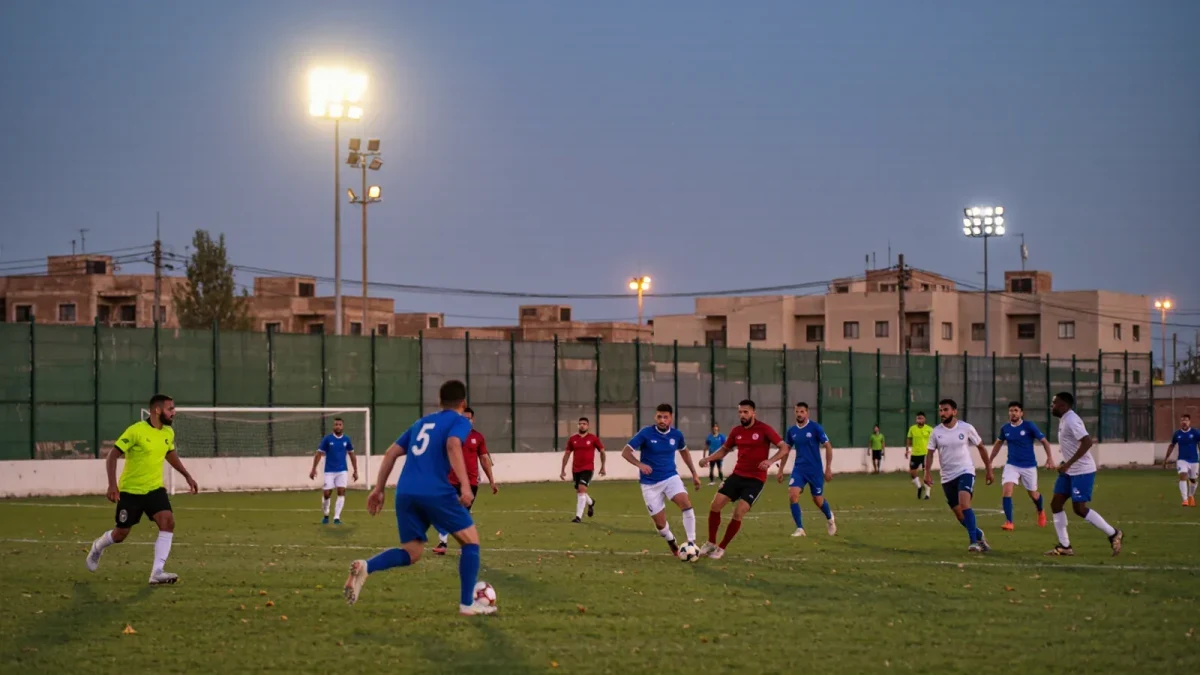
Players in the band just below elite level — the 'B-tech' tier, solid academy technicians without first-team guarantees — develop primarily through competitive matches, because the skills that decide their careers are perceptual and decisional rather than technical. Research on expertise in team sports, including work summarised in Sports Medicine reviews of perceptual-cognitive skill, consistently finds that elite performers are distinguished less by ball manipulation than by reading situations faster. That reading is trained by real opposition with real consequences. A 19-year-old who has mastered every rondo pattern but started fifteen senior matches is, in professional terms, uneducated.
What does 'B-tech' actually describe?
The term, borrowed from academy staff shorthand, describes players whose technique is clean and coachable — good first touch, both feet, tidy in possession — but who lack the physical edge, consistency or headline attribute that makes clubs commit early. They are the bulk of every age group and the backbone of professional football below the top two divisions. The label is not a ceiling. It is a description of what the industry sees at eighteen.
The problem is that the training environments these players come from are built around technical repetition with high coach control. That environment produced their strengths. It also produces a specific weakness: habits that only work when space, time and instructions are predictable.
What changes in a senior match?
Everything that drills remove, a match restores. Senior football compresses time. Opponents do not announce press triggers. Teammates make wrong runs and demand improvisation. Referees let duels go that an academy official would whistle. The player must select the right action under fatigue, contact and consequence — and then live with the result in front of teammates whose jobs also depend on it.
Coaching science describes this as training specificity: practice most improves performance in conditions that resemble the target performance. A passing square improves passing in a passing square. It does not, by itself, improve the decision of whether to pass, when, at what weight and into which channel, while a centre-back closes the body shape down. Those choices, made thousands of times under pressure, are the actual curriculum for a B-tech player.
Why does more theory not close the gap?
Because the bottleneck is not knowledge. Most players at this level can explain what they should have done within seconds of doing the wrong thing. The gap is between knowing and executing at match speed, and that gap is closed by exposure, not explanation. Video sessions, tactical boards and classroom work sharpen interpretation — they are worth something — but they train the commentator in the player, not the player himself.
- Classroom work improves declarative knowledge: what the system is, where spaces are.
- Drills improve procedural quality: touch, striking, movement patterns.
- Matches build the link: selecting the right procedure, at speed, under pressure.
A programme heavy on the first two and light on the third produces players who look excellent in April training and hesitant in August league matches. That profile is common, and it is a programme failure, not a character flaw.
How much game time is enough?
Practitioners in talent development generally converge on a simple standard: meaningful competitive minutes most weeks. Longitudinal studies of youth-to-senior transitions, including research on the professional development pathway in Scandinavian and Dutch systems, suggest that a substantial share of a young player's weekly football in the transition years should be senior competitive football — many in the field reference a rough balance where the majority of football activity comes from matches rather than training in the final development phase. The exact number matters less than the pattern: regular starts, real stakes, and a run long enough to fail, adjust and recover.
One-off appearances do not qualify. A substitute cameo every third week keeps a player sharp without developing him, because development requires the full cycle: preparation, performance, consequence, review.
What should clubs do differently?
The structural answers are well known and mostly a matter of will. Senior football must be scheduled deliberately — loans to clubs that start the player, B teams in competitive divisions, or a first-team squad plan that budgets real minutes rather than emergency ones. Training should be built around game forms — small-sided matches, wave attacks, constrained games — rather than isolated drills, so that even practice carries decision load. And selection conversations should include a development audit: how many competitive minutes did each 18-to-21-year-old accumulate this season, club-wide, as a number someone is accountable for.
What role do coaches play once the games begin?
Games do the teaching, but coaching decides how much of the lesson is retained. The most effective pattern around senior debuts is a short review cycle: a brief individual conversation within days of each match, focused on one or two decisions rather than a full performance autopsy. Players describe consistently how much they gain from being told honestly where they stand — in the team, in the pecking order, in the club's plans — because uncertainty consumes the attention that matches demand. A coach who reviews selectively and communicates plainly turns twenty scattered appearances into a coherent curriculum.
Does this apply to every position?
Largely, with different rhythms. Goalkeepers and centre-backs can survive slightly later competitive exposure because their technical curriculum is longer and error tolerance differs. Wide attackers and midfielders suffer most from theory-heavy development, because their positions demand the fastest perceptual cycles in the sport. But no position outgrows the principle. Even at the top of the game, clubs that trust young players do it by putting them on the pitch, as ongoing coverage of squad building at Reuters soccer documents season after season.
The summary for anyone advising a player in this band: choose the option with the most real matches at the highest level that will actually play you. Technique got him noticed. Games will get him paid.