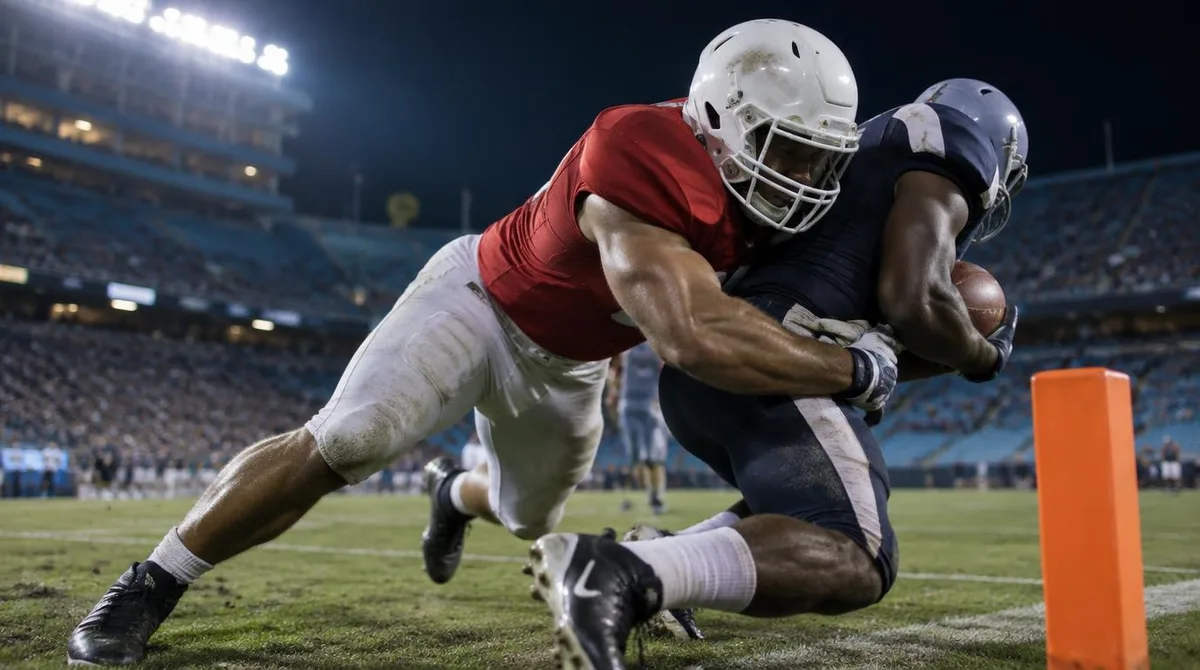
The ACC has suspended two starting players for half a game and fined both Louisville and North Carolina after a postgame brawl in Chapel Hill on Saturday, November 14. The penalties fall unevenly in practical terms: Louisville linebacker Stanquan Clark, the Cardinals' leading tackler, will miss the first half of a game his 7-3 team needs to keep its ACC championship chase alive, while North Carolina's Greg Smith III sits the first half of a 5-5 side's bowl-eligibility bid.
The conference announced the sanctions Monday morning, saying "the unsportsmanlike behavior displayed was unacceptable" and that the suspensions follow NCAA rules for fighting, per FOX Sports. Both schools also received fines — in amounts the league did not disclose — and public reprimands.
That asymmetry is the analytical story here. Louisville (7-3, 6-2 ACC) is the only two-loss team in the conference standings and remains in the race for the ACC championship game. Losing Clark, who leads the Cardinals with 74 tackles plus 7.0 tackles for loss, 1.5 sacks and an interception, for the first half against Pittsburgh removes its most productive defender from roughly half of a winnable conference game. North Carolina (5-5, 2-4), chasing bowl eligibility in Bill Belichick's second season, loses Smith — fourth on the Tar Heels with 56 tackles and the team leader with three interceptions — for the first half at Virginia. Both absences matter, but one sits inside a title calculus and the other inside a bowl math problem.
How did the brawl actually start?
The sequence is well documented across the supplied reporting. Louisville knelt out the final seconds of a 16-14 road win, and on the final snap Tar Heels defensive tackle Xavier Lewis and Cardinals offensive lineman Johnnie Brown III continued to jostle in a testy exchange. More players stepped in, tempers flared, and the incident spread into multiple skirmishes and pileups across the field before coaches and staff — including Belichick — helped separate the teams, according to Field Level Media.
The trigger point is instructive. Kneeling out a decided game is a standard act of game management, but it leaves both sides on the field with nothing to play for except pride and grievance. The final snap of a kneel-down is exactly where accumulated frustration gets its last outlet. The ACC's penalties address the escalation, not the conditions that produced it — and those conditions recur league-wide every week.
What does the ACC's penalty structure tell us?
Three features of the sanctions stand out. First, the half-game suspensions are automatic in structure: the ACC stated they are "in accordance with NCAA rules for fighting," meaning the conference applied a preset rule rather than crafting bespoke punishment. Second, the fines are undisclosed, which blunts their public signaling value — nobody outside the league offices knows what a sportsmanship violation costs. Third, the public reprimand is the only element aimed at institutional behavior rather than individual players.
The conference also said it would have no further comment, WLKY reported, which closes the door on any clarification of how the league weighed each school's role. On the available record, the two programs were treated identically despite the incident beginning with an exchange between a North Carolina defender and a Louisville lineman.
What did the coaches say?
Both head coaches addressed the incident with unusual candor about its handling. Belichick, per Field Level Media: "You play the game between the whistles; that's not what we're here for." He added, "We got out there and got everybody out as quickly as possible."
Louisville's Jeff Brohm called it an "obviously unfortunate incident" and noted the practical failure: "You try to get things broken up as fast as you can. It didn't get broken up too fast." He also conceded uncertainty about the cause: "I'd have to see what really started it. Hopefully we can correct that and not do that again."
Brohm's admission is the honest one. Neither coach claimed full knowledge of the ignition point, and the ACC's own statement did not assign one. The gap between what happened on video and what the sanctions explain is where the league's disclosure stops. We covered a connected angle in Why the modern full back role soccer demands never stops.
What happens on the field this Saturday?
The suspensions take effect immediately, and both affected games carry stakes. Louisville hosts Pittsburgh needing a win to stay positioned in the championship race as the league's only two-loss team. North Carolina visits Virginia at 5-5, one win short of bowl eligibility, in Belichick's second season in Chapel Hill, as FOX Sports Radio summarized.
For Louisville, the first-half plan without Clark becomes a coaching problem: replace 74 tackles' worth of production for two quarters against a conference opponent, then reintegrate him at the break. For North Carolina, Smith's absence weakens a secondary that produces its interceptions at the top of the depth chart. Neither team gets a scheduling break from the brawl; both get a harder first half.
The wider question the ACC left unanswered
The disclosed record establishes what the penalties are but not how the league weighed fault. Undisclosed fines and a no-further-comment posture mean the public cannot compare this case against future ones, which is precisely what makes a sportsmanship policy credible as a deterrent. The measurable cost lands on two individual starters, both of whom were starters and both of whom lose half a game — a sanction calibrated to hurt competitively without derailing either season. Readers following this should also see Why ESPN Made Less Money From a Record NBA Season.
Whether that calibration holds the next time a kneel-down turns into a pileup is the open question. The rulebook responded on schedule this time. What remains unknown is whether the league's silence on fine amounts and fault allocation will make the next incident more or less likely.