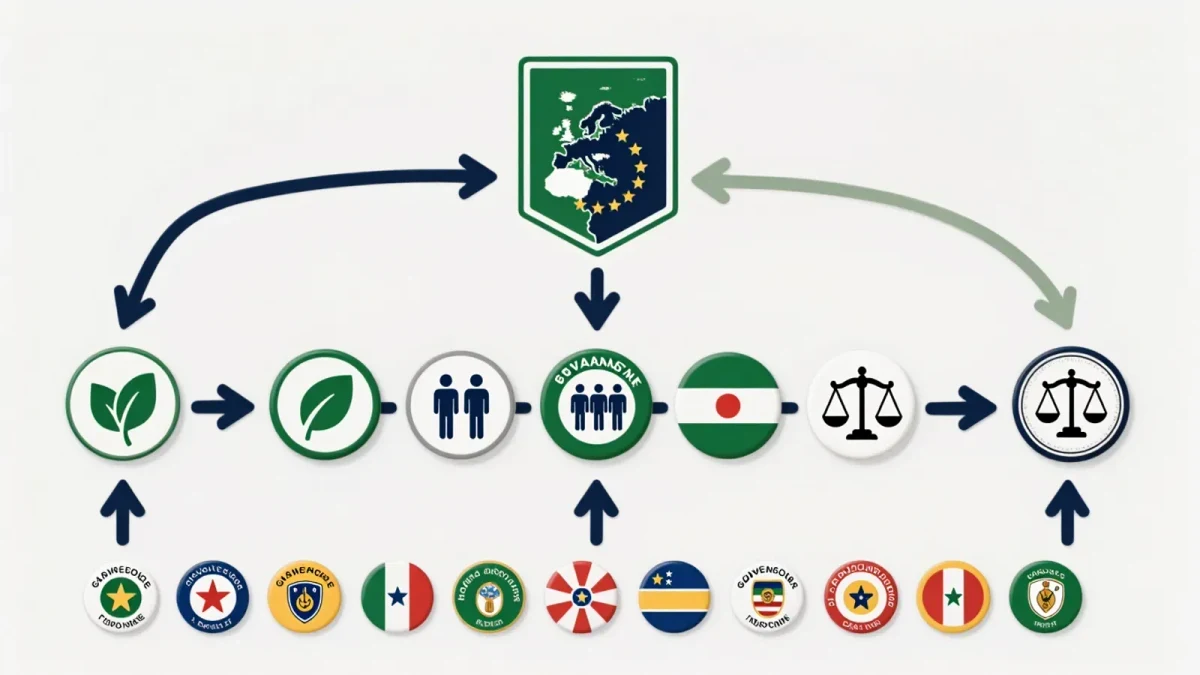
UEFA's sustainability standards reach clubs not through campaigns but through paperwork that clubs cannot avoid. The mechanism is the club licensing system: to play in the Champions League, Europa League or Conference League, every club must satisfy criteria set out in UEFA's Club Licensing and Financial Sustainability Regulations, and since UEFA launched its cross-cutting sustainability strategy in late 2021 — a framework running to 2030 covering human rights, environmental protection and governance — those criteria have steadily absorbed sustainability content. Under the current regulations, clubs must appoint a sustainability manager and adopt policies across defined areas as a condition of European participation. It is the same channel that once delivered financial fair play, and it works because a licence refusal means exclusion from competition (Reuters, 2022).
Why is licensing the delivery vehicle?
UEFA governs associations and competitions, not individual workplaces. It cannot inspect every training ground, but it decides who enters its tournaments. Club licensing turns that gatekeeping power into policy reach: national associations implement UEFA's criteria domestically, and domestic leagues adopt aligned requirements for top-division clubs, so standards written in Nyon effectively arrive at clubs through their own national federations. A rule that starts as a condition for 300-odd European competitors becomes the baseline for thousands of professional clubs through the pyramid of associations below.
What do the environmental requirements cover?
UEFA's environmental policies sit inside a broader 2030 strategy with more than a dozen policy areas, from climate action to circular economy. For clubs, the practical obligations cluster around measurement and management: understanding energy, water and waste performance at stadiums and training facilities, producing improvement plans, and reporting through their associations. UEFA's own venues have carried the message — its tournament finals and European Championships have been run under carbon measurement and reduction programmes, with Euro 2024 in Germany explicitly framed by UEFA as part of a plan to cut emissions associated with its events, including fan travel, which typically dominates the footprint of any tournament. The spillover logic is simple: clubs that document environmental performance for Europe keep doing it domestically.
How do social and governance standards translate?
The social pillar reaches clubs through requirements on equality, inclusion and child safeguarding. Licensing criteria oblige clubs to have anti-discrimination policies, designated safeguarding officers for academies, and accessible provision for disabled supporters, an area where English clubs in particular have been transformed by decades of access audits. Governance requirements push in the same direction: clubs must show clear ownership information, fit-and-proper checks on directors through national rules, and structured dialogue with supporters. None of this is voluntary goodwill; it is scored against licensing criteria that national associations verify each season, with sanctions ranging from warnings to licence refusal for the worst failures.
Does any of this affect wages and spending?
Yes — through the renamed financial sustainability rules, which folded the old financial fair play framework into the same licensing package. Clubs in European competition are subject to squad cost limits that cap spending on wages, transfers and agent fees relative to revenue, with the ceiling tightening in phases toward 70% under UEFA's football earnings rule structure. The sustainability strategy borrows the same enforcement architecture: declarations are audited, breaches trigger sporting and financial penalties, and repeated failure puts the licence itself at risk. Financial discipline is treated by UEFA as one dimension of sustainability, alongside ecology and governance, under a single reporting roof.
What pressure do the standards face?
Skeptics raise two objections. First, scope: licensing bites hardest on clubs that qualify for Europe or sit in top divisions, while lower-league clubs depend on national implementation, which varies widely across 55 associations. Second, measurement: environmental reporting standards in football are still maturing, and clubs can satisfy documentation requirements without cutting absolute emissions, particularly where fan travel — the largest emission source at most matches — sits outside club control. UEFA's response has been to align with external frameworks, including partnership work with UN bodies and public commitments made in connection with sport-sector climate initiatives, rather than inventing football-only metrics.
Why should supporters care?
Because the standards quietly shape matchday. Accessible seating, safer stadium environments, safeguarding in academies, anti-discrimination reporting lines and fair-ticketing dialogue all trace back to criteria clubs must meet to keep their licences. Sustainability at UEFA level is not mainly about solar panels on stadium roofs; it is about attaching social and environmental obligations to the commercial engine of European football, so that a club's licence to compete carries duties beyond the pitch. That is the strategy's real design, and it is why its effects show up in the least glamorous documents a club produces: its annual licence application.