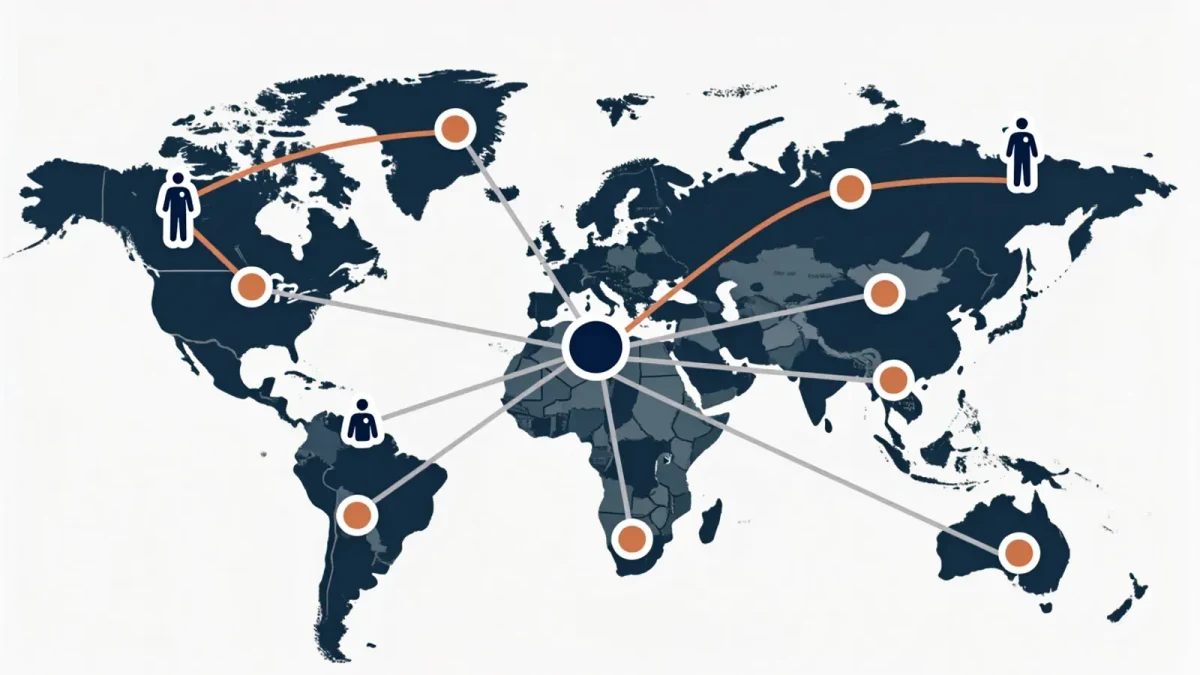
Multi-club ownership changed recruitment because it turned individual transfers into internal pipeline decisions. FIFA's January 2024 study of the phenomenon, covered by Reuters, counted 88 multi-club groups controlling more than 200 clubs worldwide, and the biggest networks now move players, data and coaching methods between continents without ever negotiating with an outsider. The transfer market did not just get new owners; it got new pipes.
What does a multi-club group actually look like?
The structures vary but the logic is consistent. City Football Group, the network anchored by Manchester City, grew to more than a dozen clubs across Asia, the Americas, Europe and Oceania by the mid-2020s. Red Bull built a vertically integrated pyramid from lower-division Austrian football up to the Bundesliga and beyond. Other investors assembled looser confederations, pairing a European hub with feeder clubs in Belgium, France or South America where squad places are easier to fill and young players can accumulate senior minutes. In each model, the group operates a shared technical identity: common playing philosophy, common data standards and a central sporting staff that treats all rosters as one extended squad.
How does recruitment work inside a network?
Instead of scouting a player and competing in an open auction, a network signs the prospect once and then manages his pathway. A teenager identified in South America might be registered with a satellite club, loaned to a Belgian affiliate for work-permit and development reasons, and promoted to the flagship squad only when the performance data justifies it. Recruitment staff evaluate acquisitions against the needs of the whole group rather than a single team, which changes valuations: a player surplus to the hub's requirements is an asset to be developed elsewhere, not a mistake to be sold at a loss.
- One signing serves many squads, so groups can outbid single clubs for prospects.
- Loans between affiliates replace external loan moves, keeping development in-house.
- Shared data systems let the hub monitor every player in the network daily.
- Work-permit and registration strategies use whichever jurisdiction fits the player's passport.
Why did regulators step in?
Two problems pushed governing bodies to act. The first is sporting integrity: clubs under shared control can end up in the same competition, where a transfer or loan between them could distort results. The second is financial fair play: inflated or strategic transfers between related clubs could artificially boost revenue. UEFA responded in 2023 with rules restricting player loans between clubs in common ownership, and FIFA tightened its loan framework to cap the number of international loans per player and per club from the mid-2020s. The Premier League also strengthened its rules on related-party transactions, requiring dealings between associated clubs to be tested against fair market value.
What changed for the loan market?
The loan system became the visible frontline. Chelsea's practice of contracting large squads and sending dozens of players out on loan each season, with more than 30 players out on loan at points in the early 2020s according to BBC reporting, illustrated how temporary moves had become a development industry of their own. Inside multi-club groups, that industry turned inward: the affiliate clubs receive players whose wages and registration are managed at group level, and the parent club receives guaranteed minutes for its prospects without relying on a rival's goodwill. UEFA's 2023 loan restrictions, which limit deals between clubs under the same ownership, were aimed squarely at this practice.
What are the benefits and risks for players?
For a young player, a network can offer a mapped pathway: a contract early, guaranteed senior football somewhere in the group, and coaching in a consistent style. For established players, the picture is mixed, because a network can park a contract in three different countries and the player has less leverage over his destination than in an open transfer. Squad-building at feeder clubs also raises competitive questions inside their own leagues, where rivals argue that an affiliate's sporting decisions serve a parent club hundreds of miles away rather than its own supporters.
| Aspect | Single club | Multi-club group |
|---|---|---|
| Recruitment scope | One squad, open market | Group-wide pool, internal priority |
| Development loans | Negotiated with other clubs | Directed between affiliates |
| Data and scouting | Club-specific systems | Shared group infrastructure |
| Regulatory scrutiny | Standard transfer rules | Loan caps and fair-value tests |
Is the model still expanding?
Every indication through the mid-2020s said yes. FIFA's 2024 count showed the number of multi-club groups rising year over year, with investment continuing from North America, the Gulf and Asia. The constraint is regulatory rather than financial: as long as loan limits and fair-market-value tests keep tightening, networks will keep adjusting structure rather than shrinking. Recruitment has permanently shifted from a market of conversations between independent clubs to a hybrid system in which some of the most important transfers are internal memos. That is the lasting change, and every academy player signing with a networked club now enters a system rather than a single team.