Yahoo Sports published a game-day preview headlined "Indiana football at Washington: How to watch, odds, predictions, more" on 21 November 2026, per the article's own publication stamp. The title promises four things at once — viewing logistics, betting lines, picks and extra context — and that bundle, rather than any single fact inside it, is what deserves a second look. The same day, the USA TODAY Network's Craig Meyer filed an equivalent piece for North Carolina against Virginia, also carried by Yahoo. Two matchups, two near-identical templates, one working habit of modern sports coverage.
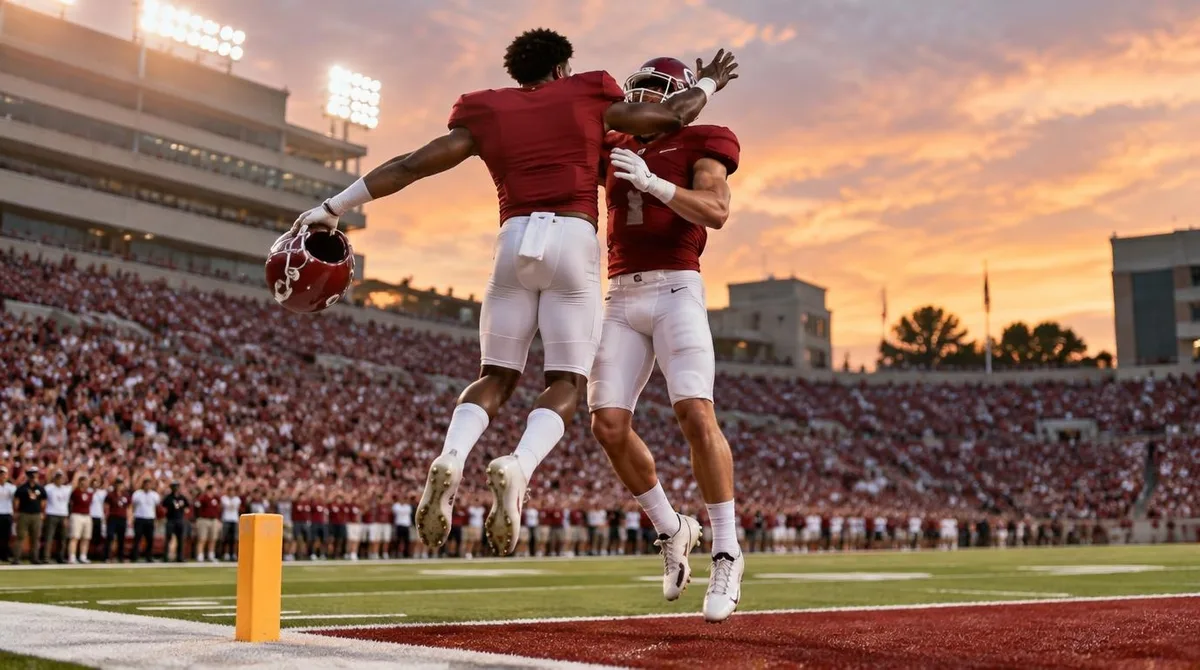
The honest qualification first: the retrieved text of the Indiana-Washington preview is thin. It confirms the article exists, its headline, its publication date and a photograph — Charlie Becker, number 80, and Nick Marsh, number 11, celebrating against the Southern California Trojans at Memorial Stadium in Bloomington on 14 November 2026, in a Justin Casterline image for Getty Images. It does not supply the kickoff time, the streaming destination or the odds in its retrieved body. So the useful analysis here is not about the line or the channel. It is about what the shape of this kind of article tells a reader, and why publications keep producing it. For readers who follow the tactical side of the game, the same habit of reading structure before substance applies — it is the core of good analysis in any sport.
Why do these previews exist in this exact form?
Because they answer a search, not a question. A fan types "Indiana Washington how to watch" into a browser, and the headline is engineered to catch every variant of that intent: where, time, streaming, odds, predictions. The genre is a service wrapped around a fixture. Its value is completeness and speed, not depth — which is why it runs roughly two minutes of reading time in the comparable North Carolina-Virginia piece credited to Meyer. Nothing in that format is dishonest. It is simply built for a reader with a different job than the one this site's usual audience brings to a match piece.
The structure also reveals the economics. A preview that must serve logistics, betting and prediction readers simultaneously can be produced quickly and at scale, fixture after fixture. The byline pattern supports that reading: the North Carolina piece carries a named USA TODAY NETWORK writer, while the Indiana-Washington entry is credited simply to "story by" the outlet. Syndication and templating, not individual match expertise, carry the load. That is a fair trade as long as the reader knows what they are holding.
What can actually be said about Indiana at Washington?
Less than the headline implies, on the evidence retrieved. What is verifiable: the fixture is real and imminent as of 21 November 2026; Indiana's most recent documented on-field moment in the source material is that photograph from the Southern California game six days earlier, showing Becker and Marsh celebrating in Bloomington. The image caption is a legitimate primary artifact — it dates the game, names the venue and identifies two players — but it is a celebration, not a result. The retrieved text does not state who won that night, and this piece will not guess.
This is where the genre earns its criticism. A headline promising "odds, predictions, more" invites the reader to assume substance sits behind it. Sometimes it does. Sometimes the "more" is a paragraph of schedule context and a photo. The disciplined habit — the one this site applies to every sport-news item it covers — is to separate what a source states from what its packaging suggests. A headline is a claim about contents; only the body settles it.
Why does this matter for how fans read a matchup?
Because the preview format quietly frames how a game is discussed. When logistics, odds and predictions arrive in one package, the betting line becomes the default summary of the matchup — a single number standing in for everything two teams are. A reader who wants to understand the game itself has to look past that frame. The alternative is not complicated: start from what is documented, treat the line as one market's opinion rather than a fact, and let the match supply the rest. Fans who want a model for that reading can see it in why Valpo's trip to Dayton is the game that defines its season, where the fixture's meaning is argued from evidence rather than asserted through a number. This connects to our earlier piece, Why Valpo's trip to Dayton is the game that defines its season. For related coverage, see Why Valpo's trip to Dayton is the game that defines its season.
There is also a cross-sport lesson worth stating plainly. American college football coverage is visibly built on templated game-day pieces produced across fixtures on the same Saturday, as this weekend's paired Yahoo previews show. The reader's defense is the same in any sport — know which layer you are reading. For related coverage, see Soccer tactics styles explained — Possession vs. counterattacking: which styles actually win football matches. This connects to our earlier piece, Soccer tactics styles explained — Possession vs. counterattacking: which styles actually win football matches.
What should a reader take from the Indiana-Washington coverage?
Three things, all supported by the record. First, the fixture is real and was being previewed nationally on 21 November 2026, alongside other games such as North Carolina at Virginia. Second, Indiana's recent documented history includes a home game against Southern California on 14 November, with Becker and Marsh among the players on the field that night. Third, the specific details a fan most wants — time, channel, line — live in the source articles, not in the fragments retrieved here, and anyone who needs them should read the Yahoo Sports preview directly rather than rely on a summary of it.
The next development to watch is not the scoreline. It is whether the preview genre keeps absorbing the analytical function — predictions edging out actual breakdown — or whether outlets begin splitting the two again. The template on display this Saturday suggests the consolidated format is still winning. The evidence for the counter-trend, on this weekend's showing, has not yet arrived.