A derby is a city arguing with itself on schedule. When two clubs from the same metropolis meet, the match settles nothing and resolves everything: which side of the river is louder, which district's grandfathers were right, whose version of the city's story gets told for the next month. The divide is rarely random — it usually tracks history that predates football, and BBC Sport's recurring coverage of derby rivalries keeps documenting how the fixtures map onto class, industry and geography rather than mere sporting fortune.
Why do so many derbies follow old social divides?
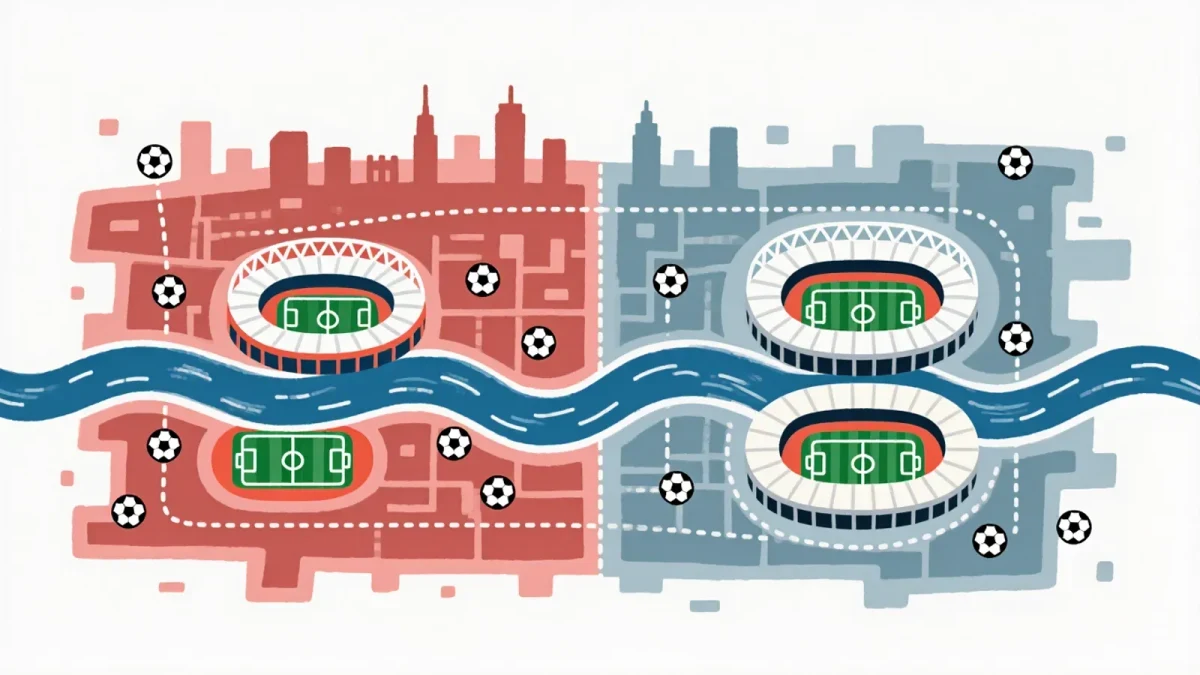
Because clubs were founded inside communities, not above them. In industrial cities, one club often grew from a factory district while another drew from the merchant quarters or the other bank of the river. When the factories closed, the boundary survived in the fixture list. The derby became the one institution that still acknowledged the divide after the economy stopped doing so. Historians of the game describe this pattern repeatedly: Everton and Liverpool split from the same city roots, Inter and Milan separated in 1908 over a disagreement about who the club was for, and Celtic and Rangers carried Glasgow's religious divisions into the twentieth century's football calendar. The football did not create the split. It preserved it, gave it a date and, crucially, gave it a scoreboard.
What happens to a city on derby day?
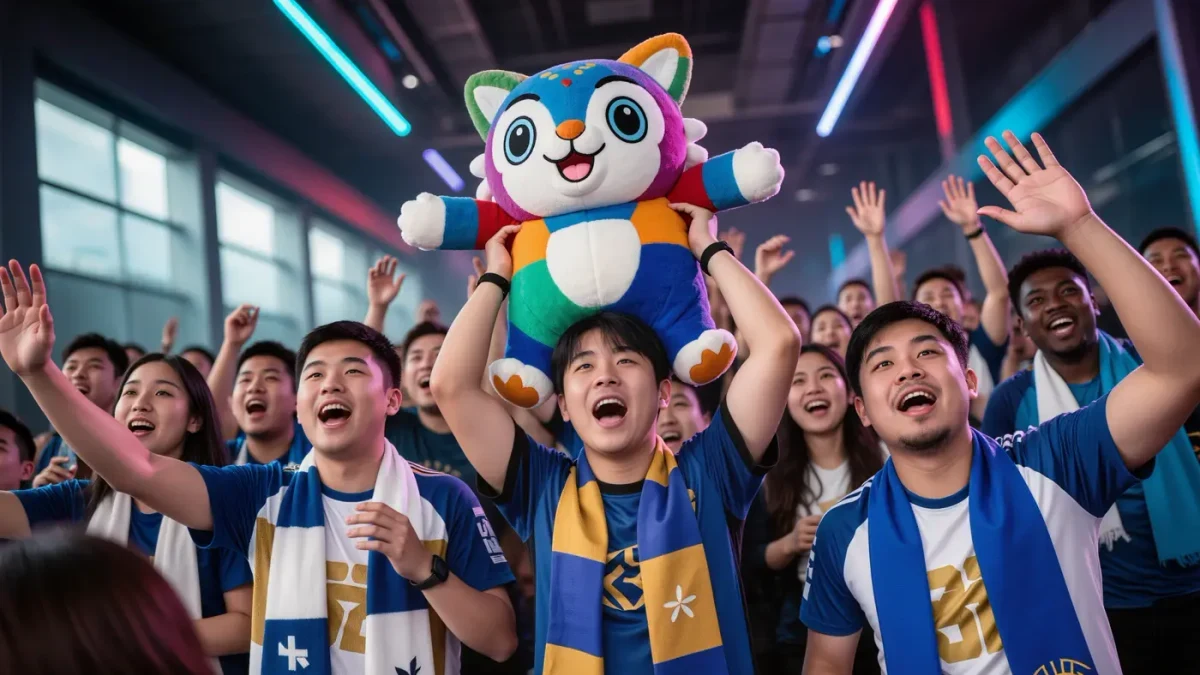
The match colonises the geography. Pubs declare for one side or the other, sometimes by explicit decoration, sometimes by unspoken custom that everyone somehow knows. Taxi drivers take sides. Bakeries and barbershop windows fill with the appropriate colours. Public transport reorganises itself around the fixture — separate stations, staggered kickoffs, police lines drawn through the centre like a seam. For twenty-four hours the city stops being one place and becomes two armed camps with a shared tram network.
The observable ritual usually includes:
- Colour creeping onto buildings and vehicles in the days before kickoff
- Streets emptying abruptly during the match itself, then filling with noise at the final whistle
- Family phone calls that evening between supporters of opposing sides
- A week of local radio, workplace banter and graffiti settling the aftermath
How do derbies write themselves into civic memory?
Cities remember derbies the way they remember weather disasters — by individual editions, not by totals. A specific last-minute winner becomes a date that needs no explanation: say the year to anyone in the city and they know. These matches function as civic anniversaries, retold at weddings and funerals, and the retelling is the point. Urban historians have noted that shared local narratives help bind city dwellers who otherwise never meet; the derby supplies the narrative, the villain and the punchline in ninety minutes. It is the most efficient piece of storytelling a city produces.
Say the year to anyone in the city and they know. The derby is the one date on the calendar that needs no explanation.
Can a derby outgrow football entirely?
It can, and in some cities it arguably has. The fixture becomes a shorthand used by people who never attend matches — a way of saying which part of town someone is from, which school they went to, which version of the city they inherited. Sociologists studying identity have found that football affiliation in split cities operates like an accent: it announces origin before a person says anything substantive. That is why derby hostility can persist even when both clubs are mediocre. The league table is a footnote; the boundary is the text.
What derbies encode, beyond sport
| Divide | Typical example | What the derby carries |
|---|---|---|
| Class and industry | Factory district vs merchant quarter | Memory of who worked where |
| Geography | Opposite riverbanks, north vs south | Neighborhood loyalty and stereotype |
| Religion or politics | Historical communal splits | Old conflicts in modern costume |
| Founding rupture | One club splitting from another | The argument that never formally ended |
What about cities that lost their derby?
The absence is just as telling. When a club is relegated into irrelevance, or a rival folds entirely, cities describe a strange quiet: the fixture's rhythm disappears, half the banter retires, and the identity debate loses its appointment. Supporters of surviving clubs sometimes admit the derby was the season's real horizon and the league merely the route to it. Municipal tourism officials, for their part, have learned the opposite lesson — derby weekends reliably fill hotels and bars, and economic correspondents have noted the measurable spike in match-day spending around major fixtures. Cities that have the fixture frequently undervalue it; cities that lost it understand exactly what it was doing.
Does the derby still matter to globalised fans?
Yes, and possibly more than before. As leagues become international products, the derby remains stubbornly local — the one match that cannot be exported, because its meaning is address-specific. A viewer in another time zone can enjoy the intensity but cannot fully inherit the geography. For locals, that incompressibility is now the point: in a football flattened by television money, the derby is the last fixture that requires actually being from somewhere. Cities change, populations turn over, stadiums get rebuilt on the same contested ground — and twice a season the old argument convenes again, in the same colours, on schedule, keeping the city's map of itself up to date.
How do newcomers learn which side they are on?
Not by filling in a form — by inheritance and geography. Children in derby cities are assigned an allegiance the way they are assigned a surname: a grandfather's season ticket, a parent's scarf, the school they happen to attend, sometimes simply the hospital nearest to where they were born. Newcomers to the city read the signals within weeks, because the divide organises small talk, workplace seating and which pub is safe on a match night. Urban sociologists describe this as low-cost, high-signal identity: one word — the club's name — communicates origin, loyalty and a set of loyalties' history in a single beat. It is unscientific, occasionally unfair and remarkably efficient, and it reproduces itself across generations without any institution maintaining it. The derby does the maintenance work on the city's behalf, twice a season, on schedule.