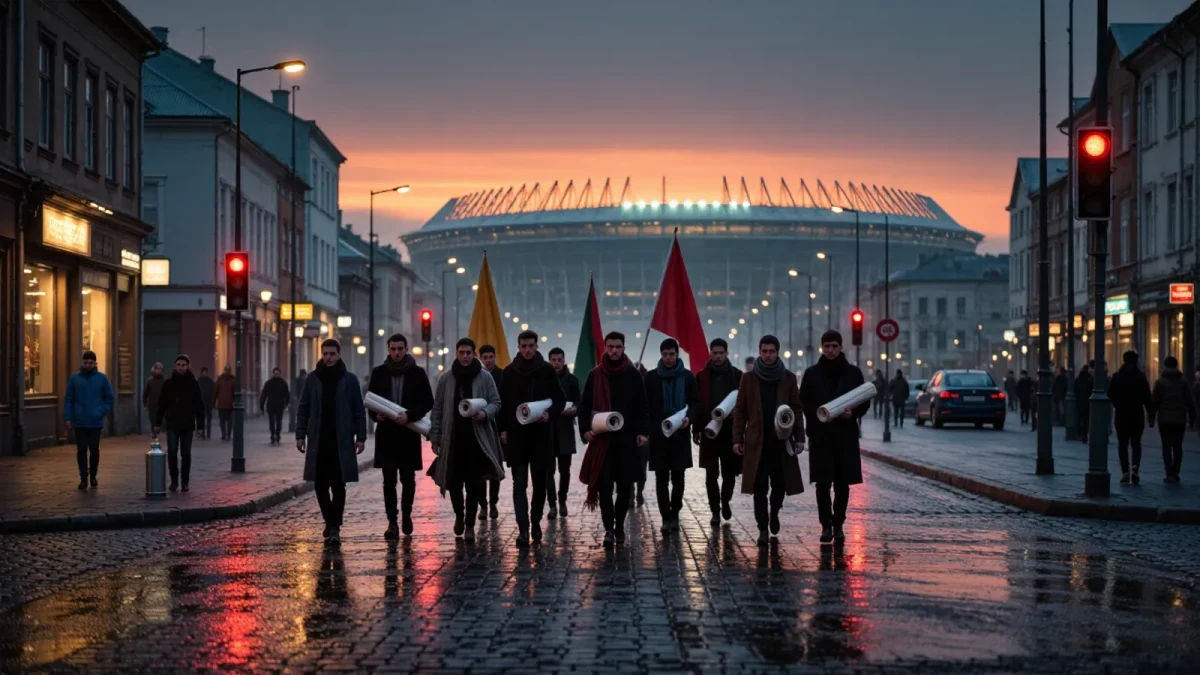
Away days persist because the match is the smallest part of them. Supporters who travel away spend, by most supporter-survey and club estimates, several hours travelling for ninety minutes of football, often in poor seats at higher effective cost — and Premier League clubs, following the league's away-ticket price cap introduced in 2016, still sell out away allocations week after week. The economics is irrational and the ritual is thriving. What the away end sells is not football; it is a compressed experience of friendship, territory and identity that no broadcast can carry, a point BBC Sport's fan-culture features have made repeatedly as away followings have grown even as television coverage became universal.
What actually happens on an away day?
A structured pilgrimage. The day begins early, in transit, with drinks and songs; it arrives in a hostile town and occupies a few pubs; it processes to the ground behind police escort or by habit; it compresses into one end of the stadium and sings for ninety minutes regardless of the score; it disperses via stations and service stations, home very late. Each stage has customs, honed over decades, and the sequence matters as much as the fixture. Ask away regulars and they describe the coach or the train as the true venue — the match is the appointment the day is built around, not the day itself.
- Transit. The coach, the train, the convoy — where the group reassembles.
- Occupation. The designated pubs, the walk through someone else's town.
- The end. The worst seats, the loudest singing, the standing anyway.
- Return. Service stations, radio phones-ins, arrival in the small hours.
Why is the away end always the loudest?
Selection and density. Away support is self-filtered: everyone present chose discomfort and cost to be there, which produces a concentrated population of the most committed — a fraction of a home crowd spread across a whole stadium versus a full allocation compressed into one end. Sociologists of sport describe away support as a performance of identity for an audience of two: the home crowd, who must be out-sung, and the travelling group itself, which confirms its own existence by singing louder than its numbers. Losing away is survivable; being silent is not. That is why the away end sings through defeats that would quieten a home crowd by half-time.
Everyone in the away end chose discomfort and cost to be there. Losing away is survivable; being silent is not.
Why hasn't television killed the away followings?
Television removed the need to attend and, in doing so, clarified the reason to. When every match is watchable at home, the away day's value proposition stops being information — who won — and becomes experience: the town you would never otherwise visit, the pub your group has drunk in for twenty years, the specific ache of a Tuesday night in a distant city. Broadcast-era football should, on paper, have emptied away ends. Instead, in England's top tiers, away allocations remain among the hardest tickets in the sport, and the league has legislated to keep them affordable, recognising that the travelling support is part of the product broadcasters are buying. The screen made attendance optional, and optionality is precisely what turned the away day from attendance into a ritual.
Home match vs away day, as experienced
| Dimension | Home match | Away day |
|---|---|---|
| Commitment | Mixed crowd | Self-selected core |
| Duration | ~3 hours | Full day or more |
| Social role | Routine | Event, often with travel group |
| Sense of place | Familiar | Hostile territory |
| Memory | Blurs | Endures — the day, not just the match |
What do away days do for the community of supporters?
They manufacture and maintain the friendships that make a fanbase a society. Home matches are local and repetitive; away days are expeditions — shared travel, shared expense, shared risk of humiliation. Anthropologists would recognise the pattern as a rite of passage repeated season after season: the road out, the trial, the return. Supporter groups that organise travel formalise it further, and weddings, funerals and businesses are known to have grown out of away-end friendships. The club provides the fixture; the supporters provide everything else, including the continuity that outlasts players, owners and stadium relocations.
Will the ritual survive the next era of the sport?
Every pressure on it is also evidence of its strength. Scheduling moved for broadcasters disrupts travel, and supporters protest; ticket pricing rises, and away caps hold; standing is restricted, and persistent standing in away ends continues regardless. The ritual bends because it predates the structures that now host it — organised away travel is older than televised football, older than all-seater stadiums, and its logic is not tied to any of them. As long as football is played in one place between two communities, one of them will travel, take the worst seats, sing through the defeats and call it the best day of the week.
What do away days give a club in return?
An identity it cannot buy. Clubs spend heavily on marketing, brand consultants and community programs, and the away end delivers a more convincing advertisement for free: a visible, audible, committed population that travels across the country to represent the place. Players consistently cite the travelling support as a motivating factor, and managers deploy it — pointing to the away end at full time, thanking the fans who went to distant midweek fixtures. Clubs have learned to feed the ritual rather than fight it: subsidised travel, dedicated away-season ticket points, turning to applaud the end after matches. The economics remain marginal — a few thousand tickets — but the symbolism is foundational. When a club falls on hard times, it is the away followings that shrink last, because the people who travel are the people who stay, and every club in trouble discovers exactly who it has.