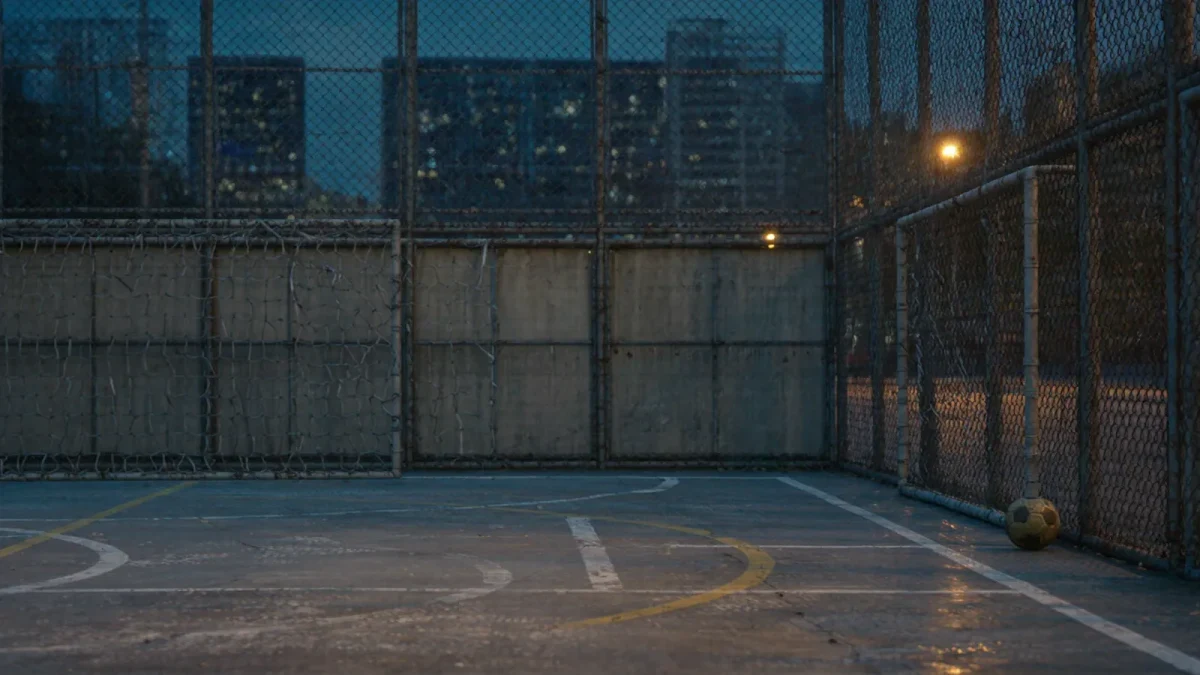
Street football feeds the professional game by teaching what organised coaching structurally cannot: repetition without instruction. Futsal, the small-court game developed in South America in the 1930s, produced a disproportionate share of Brazil's greatest players — Pelé, Ronaldinho and countless others credited small-sided street and futsal games as their real education — and FIFA's own development programs now promote small-sided formats precisely because tight spaces multiply touches. A child in a cage touches the ball several times more often per hour than a child in an eleven-a-side academy drill. The professional game noticed, and it has been trying to reimport the street ever since.
What does the street teach that academies cannot?
Decision density and consequence. In organised training, an adult designs the practice, corrects the error and resets the play. In the street, the players design everything — teams, rules, the size of the goal made from bags or sweaters — and every mistake costs something immediately: lose the ball, lose your game, wait for the next one. There is no substitute and no coach, so players learn to solve problems under social pressure, to keep the ball when outnumbered, to negotiate, to win and lose on their own authority. Coaches at professional clubs describe street-raised players as having a particular resourcefulness in tight areas, a comfort with chaos that drills do not produce.
- Touch volume. Small-sided games multiply ball contacts per session.
- Autonomy. No referee, no coach — players govern themselves.
- Consequence. Losing ends your game; waiting is the punishment.
- Improvisation. Unusual surfaces and constraints force creative solutions.
Why did the professional game start copying the street?
Necessity. As urbanisation, traffic and safety concerns emptied informal pitches in Europe from the 1990s onward, academies noticed a drying up of the chaotic skills the street used to supply for free — a shift coaches and journalists, including in BBC Sport's coaching coverage, have discussed for two decades. The response was to reconstruct street conditions deliberately: futsal programs in youth academies, small-sided games as the default training format for young ages, cage-style pitches at development centers. The Dutch and Belgian federation reforms of the 2000s embedded small-sided play at young ages; English youth development followed. The professional game, having spent a century professionalising coaching, spent the next decades trying to artificially recreate the unprofessional environment that produced its most creative players.
The professional game spent a century professionalising coaching — then spent the following decades trying to rebuild the unprofessional environment that produced its most creative players.
Which professional cultures grew directly out of street formats?
Brazil is the canonical case, with futsal and beach football feeding a national style built on close control and improvisation. Urban cage cultures elsewhere produced their own signatures: the tight courts of Mediterranean and Eastern European cities, the five-a-side circuits of Britain, the street soccer traditions of African and South American neighbourhoods whose players carried those habits into European leagues. What unites the histories is the mechanism rather than the geography: a small, hard, crowded space rewards players who can protect the ball, escape pressure and finish quickly — and those skills transfer upward. Professional scouts now explicitly evaluate how a player performs in constrained space, which is a formal admission that the cage set the exam.
Street format vs eleven-a-side development
| Dimension | Street / futsal | Organised youth 11-a-side |
|---|---|---|
| Ball touches | Very high per hour | Lower, position-bound |
| Decisions per minute | Constant, congested | Episodic |
| Adult structure | None | Coach-designed |
| Skill emphasis | Control under pressure, finishing | Positional discipline |
| Cost | Nearly free | Fees, facilities, travel |
Does the street still exist as a pipeline?
In fragmenting form. Informal play has not vanished — it has migrated into organised small-sided formats: urban five-a-side leagues, futsal clubs, caged community pitches with booked slots. The content survives even where the informality does not, and talent identification increasingly routes through those formats, especially in dense cities where full-size grass pitches are scarce. The concern among development professionals is not the formats but the freedom: a booked cage with an adult running the session is street-adjacent, not street. The most watched development trend of recent years is whether the last unsupervised play spaces can be preserved, because everyone in the system now agrees where the elasticity in the talent pool comes from.
Can a culture run on street football alone?
No professional ecosystem has managed it, and the honest version of the story is a hybrid. Street play develops individual resourcefulness; organised development sustains it, physicalises it and gives it a pathway. The feeder relationship works in both directions — street formats give academies their raw creativity, and professional visibility refills the cages with children imitating what they watched on Sunday. The street does not need the professional game, but the professional game has quietly admitted, through every futsal program and small-sided mandate it adopts, that it needs the street.
What is street football's biggest gift to the modern game?
Not any single skill but a temperament: comfort with embarrassment. Street play demands that a child try the ridiculous thing — the nutmeg, the improvised flick, the improvised rule change — in front of peers who will mock failure without mercy and reward success without adult mediation. That loop, repeated for thousands of hours, produces players who attempt low-percentage ideas under pressure, which is precisely what separates creators from technicians at the professional level. Coaches cannot simulate the mockery; the stakes in organised training are always mediated by an adult who insists everyone gets a turn. Some academies now run sessions with minimal intervention deliberately, standing back to recreate the social risk. It is an imperfect copy, and everyone involved knows it. The street's real product was never the technique — it was the environment that made the technique worth attempting, and the environment remains stubbornly difficult to manufacture.