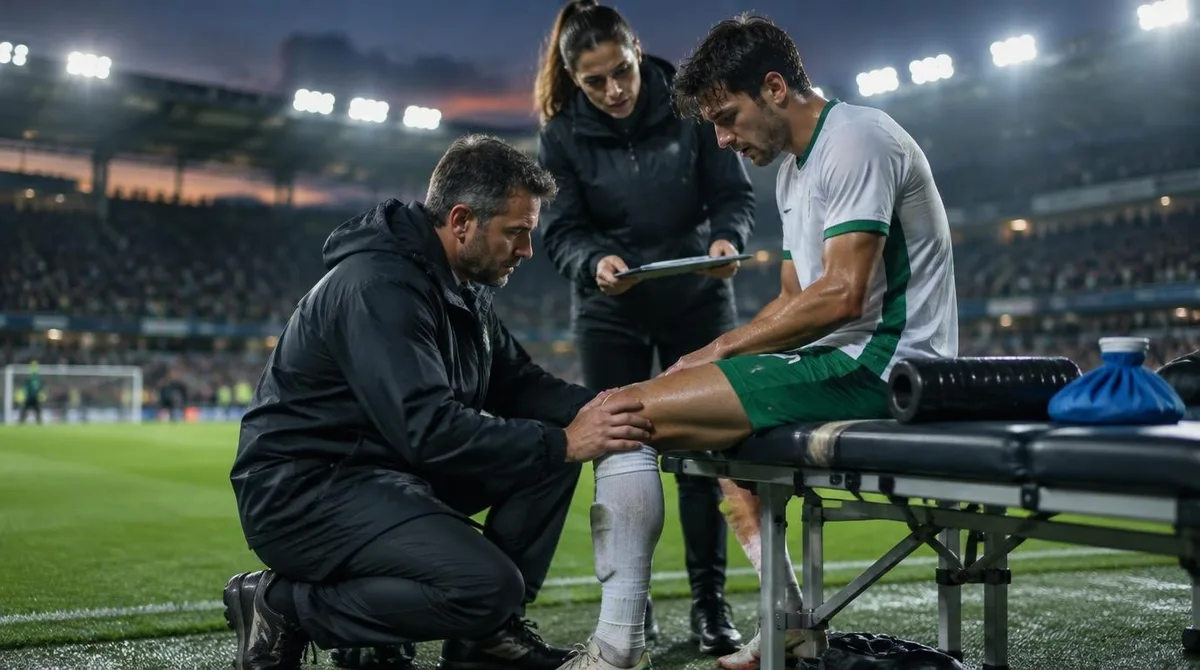
A soccer club's medical staff is not one doctor. It is a layered group: club doctors who diagnose and treat, physiotherapists who rehabilitate, sports scientists who plan training loads, strength coaches, nutritionists and analysts. Each role has a distinct job, and the boundaries between them decide whether a player returns to the pitch too soon or at the right time.
This matters because a squad's season often turns on availability. A club can sign well and coach well and still lose its way if half the starting eleven is in the treatment room. Understanding who does what — and who holds final authority when a coach wants a player back and the doctor does not — explains a quiet part of how clubs are run. As a starting point, a club is, in the basic sense, an association of people united by a common interest or goal, and the medical department is one of the specialized groups inside that larger structure.
What does the club doctor actually do?
The club doctor is a qualified physician responsible for the overall medical care of the squad. That covers pre-signing medical examinations, diagnosis of illness and injury, decisions on whether a player is fit to play, referrals to specialists, and day-to-day treatment of everything from illness to impact injuries. In most professional setups the doctor is the senior medical authority: physiotherapists and other staff report upward, and the doctor signs off on medical clearance.
Two features of the job are worth noting. First, the doctor serves the player's health, not the fixture list — at least in principle, and good clubs protect that principle in practice. Second, the doctor works with a supporting cast. A single physician cannot run matchday emergency cover, rehabilitation sessions and screening programs at once, which is why departments are layered.
How do physiotherapists and rehab staff fit in?
Physiotherapists handle the hands-on work of recovery: assessing injuries, running rehabilitation programs, and progressing a player from crutches to running to full training. In football parlance, the physio often manages the day-to-day of a hamstring strain or an ankle sprain while the doctor handles diagnosis and medication decisions.
Rehabilitation is a sequence, not an event. A typical pathway moves from restoring range of motion, to rebuilding strength, to controlled running, to sport-specific work, to full training, and finally to match availability. Each stage carries a return-to-training judgment, and the physio's progress reports feed the doctor's final clearance call. When a club's return timelines go wrong, the usual culprit is pressure to compress that sequence.
What do sports scientists and strength coaches do?
Sports scientists sit on the performance side of the department rather than the medical side. Their work is about preparing players to tolerate the demands of training and matches: monitoring training loads, tracking recovery, and advising on periodization — the planning of hard and easy weeks across a season. Strength and conditioning coaches build the physical qualities underneath that: power, speed, and resilience in the muscle groups that hamstring and groin injuries tend to attack.
The division of labor is deliberate. Medical staff respond when something has gone wrong; performance staff work to reduce the chance it goes wrong. The two groups share data in practice, because a load spike the sports scientist flags today can be the injury the physio treats next week. Clubs that keep the two functions talking tend to manage squad availability better; clubs where they operate as rival fiefdoms tend to argue about whose numbers are right while players sit out.
Who decides when an injured player returns?
In a well-run club, the decision is medical, and the doctor holds it. The coach states a need — the team is short, the match matters — and the medical staff state a risk. The club doctor's clearance is supposed to be the final word on fitness to play, because the doctor carries both the clinical responsibility and the duty of care to the player. In practice, the balance varies by club and by the relative standing of the coach, which is precisely why the question is contested inside the industry.
The honest answer is that the structure exists to keep that decision out of the coach's hands, and the quality of a club's medical culture shows in whether it succeeds. A club where the doctor's clearance is routine rubber-stamping has a problem that no hire in the transfer market will fix.
What this means for how clubs are judged
For supporters trying to read a club's competence, the medical and performance department is an underrated signal. Availability patterns across a season — soft-tissue injuries clustering, players rushed back and re-injured — say something about the department that press releases never will. It also connects to money: wages paid to unavailable players are a real cost, and squad planning that ignores injury risk wastes budget. That is one more reason the department belongs in any serious account of clubs as institutions, alongside recruitment and wage structures. We covered a connected angle in How the squad cost ratio decides what a club can spend.
The same logic runs through a club's youth setup. Academy players are still growing, and their physical development needs different programming from the first team's, which is why the best soccer academies develop talent with dedicated medical and performance staff rather than borrowing the senior squad's. And because the department's work shapes what a coach can actually select each week, its influence shows up directly in match analysis — a team missing its first-choice midfield is a medical story as much as a tactical one. For related coverage, see How the best soccer academies develop talent: four models compared.
The limits of what outsiders can know
Much of this department's work is invisible by design. Injury details are guarded, medical records are confidential, and clubs release only the minimum a competition requires. That means outside observers — including this publication — work from availability data, club statements and attributed reporting, not from inside the treatment room. Any specific claim about why a particular player missed a particular match deserves the same skepticism as any other unsourced claim.
What the evidence does support is the structural picture: a modern club keeps players fit through a layered team — doctor, physiotherapists, sports scientists, strength coaches and support staff — with distinct roles, shared data, and a medical chain of authority that exists to protect the player first. Where that structure is respected, availability tends to follow. Where it is bent to the fixture list, the treatment room fills up, and no one outside the club needs a medical degree to notice.