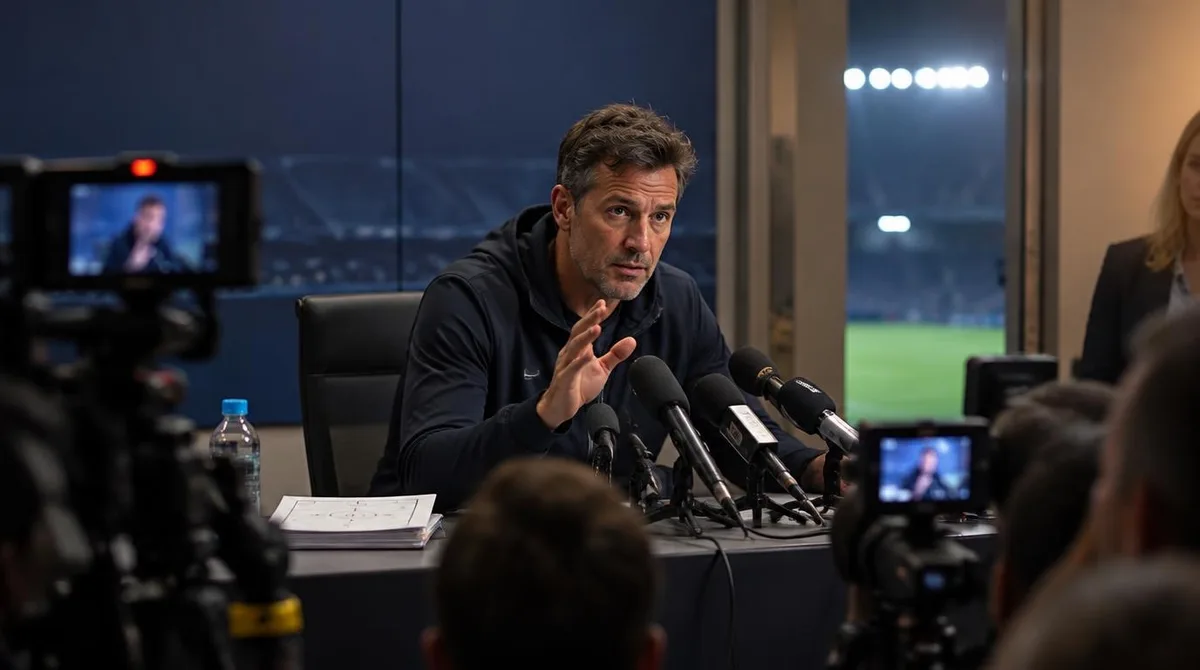
A soccer manager press conference is a performance with rules both sides know. The manager protects the dressing room, manages expectations, and sends messages to opponents, referees, and his own board. The journalist hunts for news. What gets said out loud is rarely the whole story, and the most useful information often sits in what is avoided.
Decoding it starts with one simple idea: almost nothing in front of the microphones is unplanned. Clubs brief their managers, comms staff sit in the room, and answers about selection, injuries, and tactics are shaped for an audience far bigger than the reporters asking. Even the word itself carries the game's old tension — to press someone, as Cambridge Dictionary defines it, is to persuade them to say more, which is exactly the negotiation happening in every media session.
This guide covers the standard moves: the coded phrases, the deflections, the mind games aimed at opponents, and the tells that separate a genuine answer from a managed one. It also explains what this means for readers — how to consume press conference coverage without treating spin as fact. For readers who want the wider tactical picture behind the words, the site's analysis section covers how teams actually play once the talking stops.
Why do managers speak in code before a match?
Pre-match duties are the tightest scripted. A manager will not name his starting eleven, so he talks about the squad in the plural. "Everyone is available" can mean a star is fit, doubtful, or carrying a knock — the phrasing is deliberately ambiguous so no opponent gains a team-sheet advantage. When a manager praises an upcoming opponent at length, he is often lowering expectations for his own side. When he barely mentions them, he may be signalling confidence.
Injury language has its own grammar. "He is in contention" usually means a fitness test is coming and the club genuinely has not decided. "We will see how he reacts" signals a doubt the club does not want to confirm. A flat "no" to an availability question is the rare unambiguous answer, which is why it makes headlines. The site has covered this ground in detail in its piece on how to follow soccer news without falling for fake stories, because vague fitness language is where speculation fills the gap fastest.
What are the classic deflections after a bad result?
Post-match sessions after a defeat follow a predictable sequence. First comes the result framing: a narrow loss becomes "fine margins", a heavy one becomes "a difficult day". Then the referee, the pitch, the schedule, or the fixture congestion gets a mention — never as an excuse, the manager insists, while clearly offering one. The safest deflection is praising the opponent, because it costs nothing and redirects attention.
The sharpest tell is the question a manager refuses. When a direct question about a player's future, a board conversation, or a selection call gets answered with a general point about the squad's character, that silence is the news. Experienced reporters learn to hear the non-answer. Readers should too: if a story quotes a manager on a topic he was not asked about, the actual answer was probably "no comment" in better clothes.
How do mind games actually work?
Psychological warfare between managers is real but mostly subtle. The classic moves include questioning a rival's spending, praising a rival so heavily that any draw becomes an upset, and publicly demanding more from referees before a big fixture — a soft campaign for officiating attention. Some managers target opponents directly, naming a danger man whose threat they then plan to neutralise; the praise and the game plan arrive together.
Most of it is aimed inward, though. Public criticism of his own players is a calculated risk a manager takes when the private message has stopped landing. Public backing of an underperforming player often means the opposite behind closed doors. None of this is provable from the transcript alone, which is why careful coverage labels it as reading, not reporting — the same discipline applied to transfer chatter, where a manager's "he is happy here" is a club position, not a verified fact. The site's explainer on how the double pivot changed modern buildup play shows what the tactical substance looks like once the media noise is stripped away.
What signals reveal a manager under real pressure?
Practical steps for spotting trouble: watch the length and warmth of the answers. A manager on secure ground argues his case with specifics — pressing triggers, shape changes, the plan for the next fixture. A manager whose job is in doubt retreats to process language: "we work hard every day", "we take it game by game", "that is a question for the club". Deflecting board questions to the club is standard; doing it repeatedly, in a flat tone, after weeks of bad results, is a different signal.
Another marker is the tone shift toward young players. A manager publicly shielding a teenager from criticism is normal care. A manager suddenly praising academy graduates at length, in a squad short of senior options, often reads as a man preparing supporters for a lean run. These are readings, not facts, and good coverage keeps the distinction visible — a habit worth applying to every headline built on a single quote.
What this means for how you read the coverage
Treat every press conference quote as a message with an audience, not a statement of fact. The manager's own club is the attributed source of his claims about its players and plans — that is a position, not independent verification. Watch what the question was, not just what the answer was. And when a quote seems designed to move a market, a fanbase, or a rival's preparation, say so in your own head before sharing the headline.
The best coverage pairs the words with the evidence: the match data, the published accounts, the documented record. That pairing is the whole difference between reporting what a manager said and reporting what is true. Readers who want the mechanics of how the rest of the media machine works can find it in the site's piece on how soccer broadcasts are made, which covers the same matchday from the production side.
Where the press conference fits in the bigger picture
The media session is one node in a club's whole communication system — the comms staff, the embargoed interviews, the club channels that now let managers speak without journalists in the room. That shift has made the open press conference more valuable, not less: it remains one of the few settings where a manager can be questioned in real time rather than quoted on his own terms. The evidence a careful reader needs is still the same. What was asked, what was avoided, and what the record shows once the talking ends.