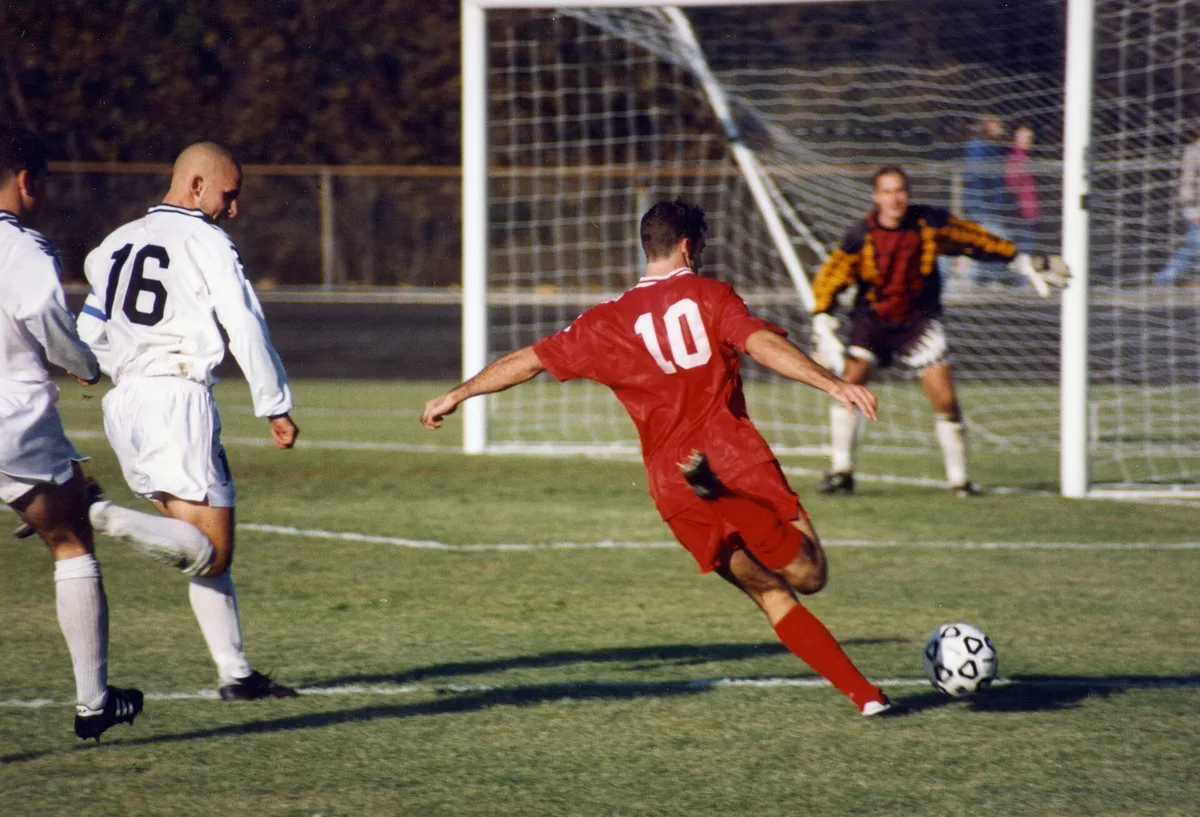
A false nine looks, on paper, like any other striker. The shirt number is the same. The job is not. Instead of staying high against the last line of defence, the forward keeps dropping into midfield, into the zone where a centre-back feels least comfortable.
That single movement is why the role still unsettles rigid defensive structures. A defence built on fixed zones and fixed matchups has no clean answer to a forward who refuses to stand still. This article explains what the role involves, where it came from, and why it keeps causing chaos at the highest level. Readers following this should also see Why the low block still beats better teams.
What a False Nine Actually Is
According to Wikipedia's overview of forward positions, a false 9 is an unconventional lone striker or centre-forward who drops deep into midfield, a role closer to an advanced playmaker than a classic goal poacher. The name comes from the number nine, the traditional shirt of the centre-forward, a player who once stayed close to the line of defenders until it was time to run at goal.
The key attributes mirror those of a deep-lying striker. Dribbling lets the player exploit space between the lines. Short passing links him to the midfield. Vision finds teammates making runs from deep toward goal.
The Dilemma It Creates for Centre-Backs
The false 9 creates a problem for opposing centre-backs, and it reduces to a simple choice. Follow the dropping forward, and space opens behind for onrushing opponents to exploit. Hold the line, and the forward gets time and space to dribble or pick out a pass.
Either answer bends a rigid shape. When the centre-back steps out, the flat line behind him breaks, and a second attacker runs into the gap. When he stays, an unmarked player collects the ball between the midfield and the defence, in the exact zone a compact block is built to deny.
Deep Roots of the Role
The idea is far from new. Wikipedia credits Juan Peregrino Anselmo of Uruguay as the first false 9 at a World Cup, in 1930, and records Matthias Sindelar filling the role for Austria in 1934. Nandor Hidegkuti then acted as a deep-lying centre-forward for the great Hungary side of the early 1950s, and English football was astounded when Hungary won 6-3 at Wembley in 1953.
Johan Cruyff later dropped deep from the centre-forward post to confuse his markers and open space for others, a usage some pundits now call a precursor of the modern false 9. Spain used Cesc Fabregas in the role at Euro 2012, and Lionel Messi defined it under Pep Guardiola at Barcelona.
Why Rigid Structures Suffer Most
Formations are written as bands of players, with defenders listed first, and a rigid block depends on those bands holding shape together. Pull one player out of the band and every spacing rule behind him wobbles.
The strikerless version pushes the same logic further. As Wikipedia's formation guide notes, the 4-6-0 sacrifices an out-and-out striker for a mobile front four that opposition defenders cannot mark without being pulled out of position. A false nine does the same damage from a shape that still looks normal on the team sheet, which is exactly why it is harder to prepare for.
How Teams Try to Contain It
There is no perfect answer. One noted approach is congestion: send several players back into defensive roles to deny the false nine the space he needs to create plays. That path is linked with Jose Mourinho's so-called parking the bus strategy, in which the whole team sits deep and compact.
Man-marking steps out with the forward, while zonal schemes hand the problem to whoever is nearest. Both plans demand constant communication and mobility, which is precisely what the most rigid defensive structures lack. The false nine keeps disrupting them because the question he asks never goes away.
Conclusion
The false nine endures because it attacks the assumptions of a structured defence rather than any single player. It turns a clear matchup into an unsolvable choice, and each new generation of technical, mobile forwards proves the dilemma still bites.
For coaches, the lesson is that defensive shape must stay flexible enough to answer movement with movement. For analysts and fans, it is a reminder that the most disruptive ideas in football are often the oldest ones, refreshed by new talent. This connects to our earlier piece, How multi-club ownership changed recruitment across world football.