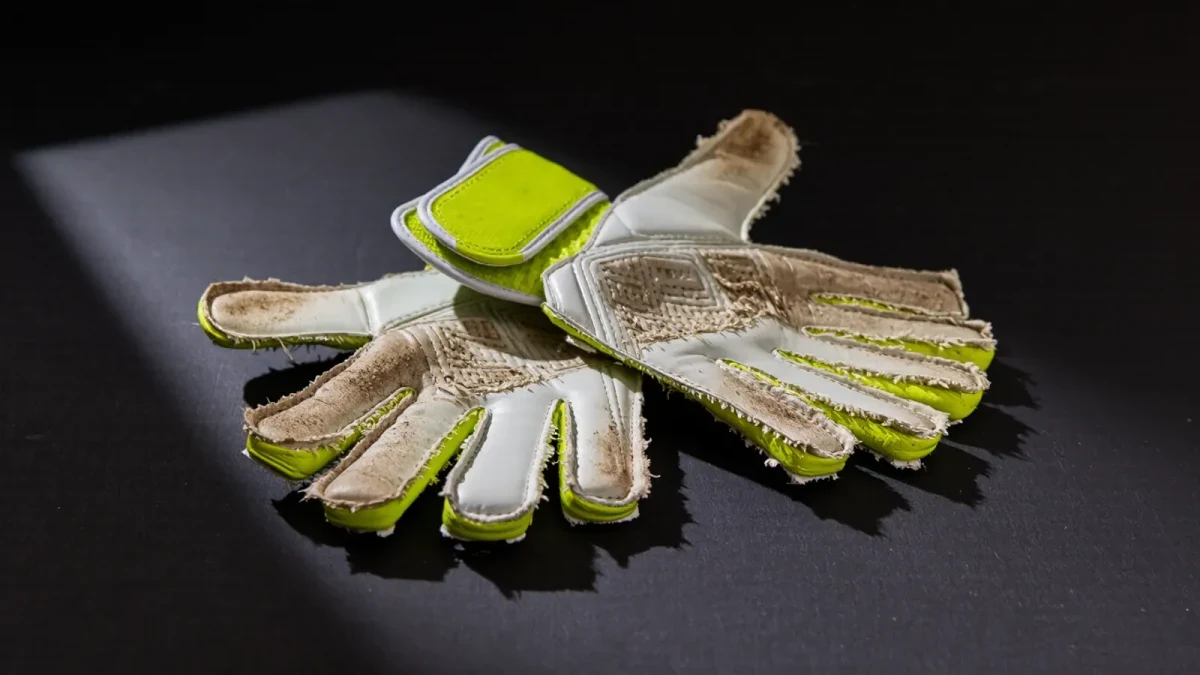
Goalkeeper gloves became collectibles because they were never meant to be kept. A match-used pair survives one professional at most — top keepers routinely wear through dozens of pairs a season — and the latex palm that gives gloves their grip decomposes within years, a durability problem glove manufacturers openly acknowledge in product guidance. That built-in mortality is the foundation of the collecting market: match-worn pairs from major finals and historic saves are scarce by nature, and auction houses now handle goalkeeper memorabilia alongside shirts, with significant sums recorded for gloves tied to famous moments, a market tracked by Reuters and other outlets in their sports-memorabilia reporting.
What turned equipment into memorabilia?
The same machinery that turned shirts into memorabilia, running a decade late. Match-worn shirts became a graded, auctioned asset class as authentication improved — photo-matching, tagging and provenance documentation — and the infrastructure eventually looked for new inventory. Gloves were the obvious adjacent category: visibly match-used, unambiguously positional, and carried an underdog romance. A shirt can belong to anyone on the pitch; a pair of gloves belongs to exactly one person, the last line, the player whose equipment is functionally part of his body. Collectors respond to that specificity. The gloves do not just say a keeper played; they show where he dived, how hard he worked, how the game treated him.
Why do collectors love the wear?
Because damage is documentation. A shirt is laundered and looks the same in the frame whether the match was a 5-0 stroll or a penalty shoot-out. Gloves arrive from a shoot-out looking like they survived one. Latex shredded at the heel, palm ground down by dives on hard ground, finger-protection straps stretched — every mark corresponds to a movement that can be traced on video. Serious collectors of match-worn equipment treat condition as a story rather than a defect, which inverts the logic of most collecting categories, where mint condition rules.
- Shredded palm latex — repeated diving and turf contact.
- Worn fingertips — high-contact shot stopping.
- Stretched straps — the keeper's personal fitting habits.
- Mud and grass — pitch-level provenance that laundering cannot fake.
How did the retail side feed the collecting habit?
By making gloves a designed object. From the 1990s onward, gloves acquired signature lines, colourways, personal name printing and limited releases — the vocabulary of sneaker culture. A keeper's signature model signals allegiance the way a basketball shoe does, and youth goalkeepers buy their hero's spec the way others buy his shirt. Manufacturers leaned in with numbered limited editions and retro re-releases of classic models, which trained a generation to see gloves as collectible objects rather than consumables. The after-market followed naturally: rare discontinued colourways and player-issue pairs, unobtainable at retail, now trade among collectors at multiples of their original price.
A shirt can belong to anyone on the pitch. A pair of gloves belongs to exactly one person, and it shows how the game treated him.
What are the specific collecting categories?
The market segments roughly the way shirt collecting does, with an extra tier of difficulty because gloves degrade. Understanding the tiers explains most of the price behaviour.
The glove collecting pyramid
| Tier | What it is | Scarcity driver |
|---|---|---|
| Retail stock, old models | Deadstock pairs from past seasons | Discontinued, latex ages |
| Limited editions | Numbered releases, retro reissues | Production numbers |
| Player-issue | Spec made for pros, not sold | Never retailed |
| Match-worn | Worn in professional games | Used, rarely preserved |
| Moment-worn | Tied to a specific famous match or save | Provenance and authentication |
Doesn't the latex just rot?
Eventually, yes — and this is the category's defining constraint and charm. Natural and synthetic latex degrades with heat, light and time; collectors store gloves cool, dark and flat, the way comic collectors once learned to bag and board. Degradation also protects the market from forgers: aging latex is difficult to fake convincingly, and genuine wear patterns are hard to manufacture. The object's mortality keeps supply permanently low, which is precisely what a collectible category wants and what a piece of sporting equipment was never designed to provide. Gloves became collector items by failing, slowly and irreversibly, at being kept.
Where is the market heading?
Toward formalisation. Authentication services that photo-match shirts are extending techniques to gloves; auction houses increasingly list goalkeeper-specific memorabilia as its own category rather than a footnote; and the retirements of a generation of iconic keepers keep feeding narratives — and inventory — into the market. Meanwhile the retail side continues its sneaker-style cycle of drops and reissues, recruiting new collectors young. The economics will fluctuate with the broader memorabilia market, but the underlying condition is stable: one keeper, one pair, one match, and a material that guarantees nothing lasts. Scarcity was never manufactured here. It was guaranteed by chemistry.
How does authentication work for a pair of gloves?
With more detective work than a shirt requires. Photo-matching a glove is possible — distinctive wear patterns, strap configuration and visible colourway details can be aligned with match photography — but the object's smaller footprint means provenance matters more: a signed letter from the keeper, a club-issued certificate, an unbroken chain from kit room to auction house. Reputable auctioneers of match-worn equipment treat gloves conservatively, often pricing them below comparable shirts precisely because certainty is harder to establish, which paradoxically keeps the category honest. Collectors learn the marks of genuine use quickly: latex wear that follows real diving patterns, palm grit consistent with a specific pitch, interior stretching that matches hours of wear rather than minutes of posing. The gloves, in other words, authenticate themselves to anyone who has worn a pair seriously. Fakes look clean. The truth always looks played in.