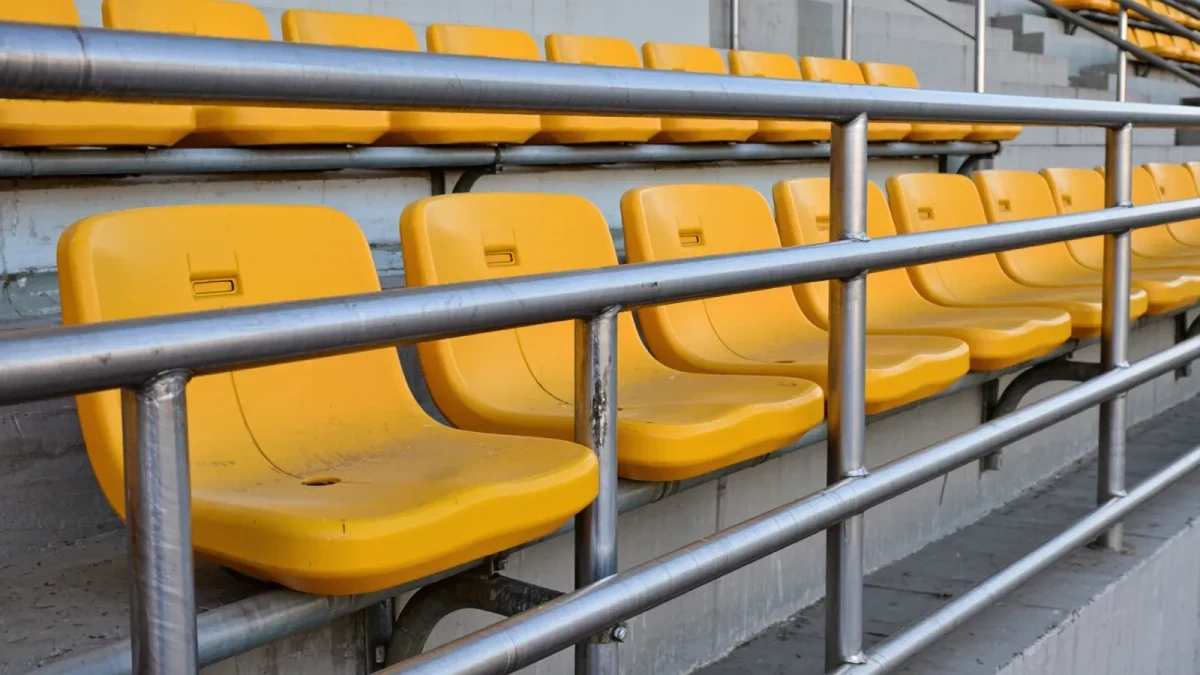
Safe standing returned to English league football through a formal licensing regime built on rail-seat technology. The Sports Grounds Safety Authority, the government's stadium safety regulator, authorised early pilot trials from January 2022, and Premier League clubs including Chelsea, Manchester United, Manchester City and Tottenham Hotspur, along with Championship side Cardiff City, were among the first to operate licensed standing areas. The seats involved are not terraces: each fan stands at a designated position behind a fold-away seat with a metal barrier — a rail seat — designed so that every row is separated from the one below by a hardened rail, removing the forward surge risk that led to all-seater requirements after the Taylor Report into the 1989 Hillsborough disaster (BBC, 2022).
Why was standing banned in the first place?
Following the Hillsborough disaster, in which 97 Liverpool supporters died as a consequence of a crush on a Leppings Lane terrace, Lord Justice Taylor's 1990 report recommended that top-flight and second-tier grounds in England and Wales become all-seater. The requirement, phased in through the 1990s, transformed stadium culture: capacities fell, standing disappeared from the top two divisions, and the rail-free terraces of the old grounds were demolished or converted. For three decades, standing at Premier League and Championship matches was a matter of persistent enforcement — stewards asking seated fans to sit down — rather than law for lower divisions, where terracing remained legal and common.
What changed the political and practical picture?
Three things converged. First, technology: rail seats, used widely in Germany's Bundesliga since the late 1990s, demonstrated that standing areas could be built with a barrier at every row and converted to seating for European matches, where standing was not permitted. Second, persistent demand: away supporters in particular stood throughout matches despite the all-seater rule, creating weekly enforcement friction that neither clubs nor police wanted. Third, legislation: the Football Spectators Act amendments in the 2020s gave the Sports Grounds Safety Authority power to license standing areas at Premier League and Championship grounds, replacing a blanket prohibition with a case-by-case approval system.
How does the licensing regime work?
Clubs apply to the Sports Grounds Safety Authority for a licence to operate a standing area. Approval depends on the ground's safety certificate, local authority agreement, and compliance with conditions: standing is limited to designated areas, seat numbers are retained so grounds can revert to all-seater configurations, and season-ticket holders in those areas occupy assigned places rather than free-flowing terraces. The model has spread steadily since the pilots — Wolves and further clubs across both divisions have added licensed areas — and the Premier League has periodically surveyed standing provision as part of its fan-facing matchday research. The direction of travel across the top two divisions has been one-way expansion since 2022.
What do rail seats actually do differently?
The engineering point is simple: old terraces had barriers every few rows, so a surge in one section could pile fans onto those in front. Rail seats put a barrier at every position — each seat's back incorporates a horizontal rail at waist height — so loads are distributed row by row and forward movement is arrested immediately. German grounds pioneered the format, and independent crowd-safety engineers have reviewed the UK installations against those precedents. Occupancy per position is also controlled: licensed areas hold fewer fans per metre than the old terraces did, trading some capacity for safety margin.
What has the return meant for matchday?
The effects fans notice most are atmosphere and away-end culture. Standing areas, particularly behind the goals, have restored the concentrated noise of the old ends, and clubs have used the conversions to strengthen home support: several have located singing sections within licensed standing areas. Away allocations have benefited too, since visiting supporters who always stood can now do so lawfully. There are trade-offs: standing areas typically reduce capacity relative to fully packed seating, ticket relocation has displaced some long-held seats, and debate continues about how clubs balance standing provision with accessible and family seating needs.
Is the model spreading further?
Within England, the licensing route means expansion is a club-by-club decision shaped by stadium structure and local authority consent, and it has continued across both top divisions since the pilots. Scotland's Premiership clubs have pursued their own trials within devolved rules, and European regulators watch the English and German models closely, since UEFA's all-seater requirement for its competitions remains in force — clubs with standing areas convert them to seats for European nights. The return of standing in England is therefore best understood not as a reversal of Taylor but as a re-engineering of it: the safety principle stayed, the technology caught up, and the law followed the evidence.